
The tree that built the nation
November-December 2026
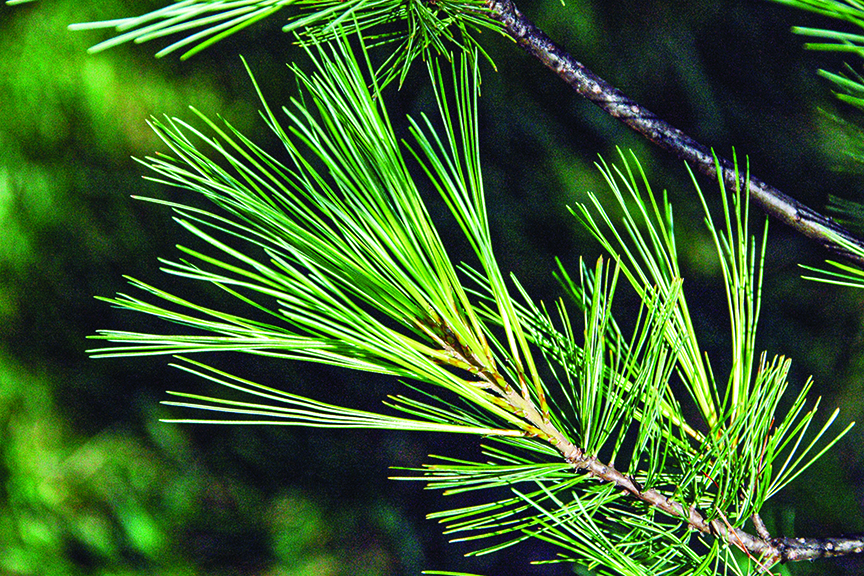
Soft, blue-green needles in bundles of five (James St. John photo via Flickr)
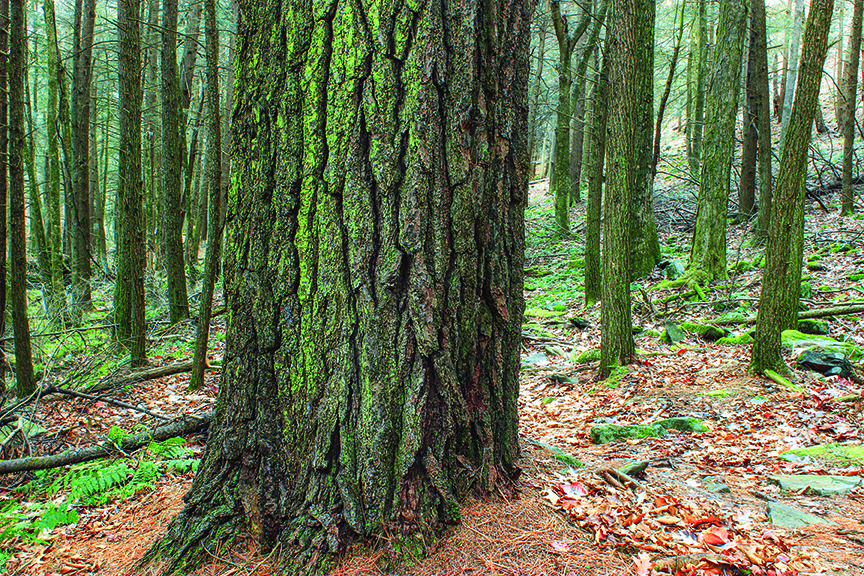
Large white pine with eastern hemlocks below (Nicholas A. Tonelli photo via Flickr)
by Steve Carroll, Contributing Columnist
While watching Ken Burns’ PBS documentary “The American Revolution” last year, I was reminded that during the lead-up to war with Britain, several state and naval flags included an image of an Eastern white pine tree. And why not, given this tree’s beauty, size and strength?
Furthermore, white pine played a crucial role in the construction of ships’ masts. Britain was forced to import smaller logs from species such as Scots pine and piece masts together, but white pine trunks were tall and strong enough to use whole. For a period, Britain marked the best trees and forbade colonists from using them. Not surprisingly, colonists found a way to harvest them anyway.
White pine wood is soft, close-grained, light and decay-resistant. It was a major timber tree into the early 20th century, and its wood has been used in paneling, house framing, window sashes, doors, furniture and much more. Native Americans used the inner bark and needles to treat coughs, sore throats and colds.
In “A Natural History of Trees of Eastern and Central North America,” naturalist and writer Donald Culross Peattie wrote, “White [p]ine, more than any other tree in the country, built this nation, literally and figuratively.”
Eastern white pine (Pinus strobus) is native to New England and southeastern Canada, west to the Great Lakes region and south along the Appalachian Mountains to Georgia. In the mid-Atlantic, it is most common in the west, less common in the Piedmont and even less common along the coast, though it is widely planted throughout. White pine’s soft, bluish-green, 3- to 5-inch-long needles are held in bundles of five, making it the only five-needle pine native to the eastern U.S. Most needles live two years, turning brown and dropping in the autumn of their second year. Trees typically reach 80 to 100 feet in height, with a given year’s branches arranged in whorls.
Individual trees produce both male and female cones, with female cones higher in the canopy. Since pines are wind-pollinated, this separation increases the likelihood that pollen produced in male cones will not be blown to female cones on the same tree. If fertilization is successful, female cones grow 3 to 7 inches long. They then dry up and open in the autumn of their second year to release the seeds. If you have white pines nearby, you are familiar with the prodigious amount of pollen — “yellow snow” — that accumulates on car hoods and windshields in the spring, as well as the brown, hard-scaled, pitch-covered female cones that drop in fall.
White pine, the tallest pine in the East, can be planted as a specimen tree, in groups or as a screen or windbreak. It does best in full or partial sun and in acidic to slightly acidic soil. It does not grow well in shade, so stands of this tree are eventually replaced by more shade-tolerant species.
White pine does face challenges. Nonnative white pine blister rust can girdle and kill trees, and white pine weevil larvae feed on and kill the tips of dominant stems. Deer may also damage trees by rubbing trunks or eating foliage. On a positive note, the seeds nourish numerous birds and mammals, and caterpillars of more than 200 butterfly and moth species feed on the needles.
Should you decide to plant white pine, a number of cultivars are available in the nursery trade. Just be prepared for the accumulation of spring pollen and autumn cones.
Steve Carroll is a botanist and ecologist who writes about trees, gardening and the world of plants. He is the co-author of “Ecology for Gardeners,” published by Timber Press.
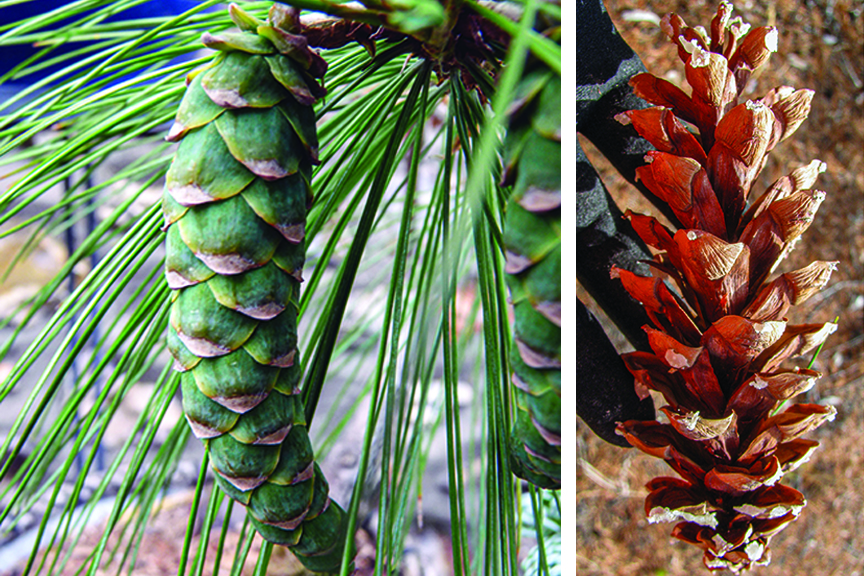
At left, a female cone in spring of second year. At right, a dry, open female cone. (Laurent Houmeau photo and Forest and Kim Starr photo via Flickr)