
Uniting generations, preserving Appalachian history and culture
October 2026
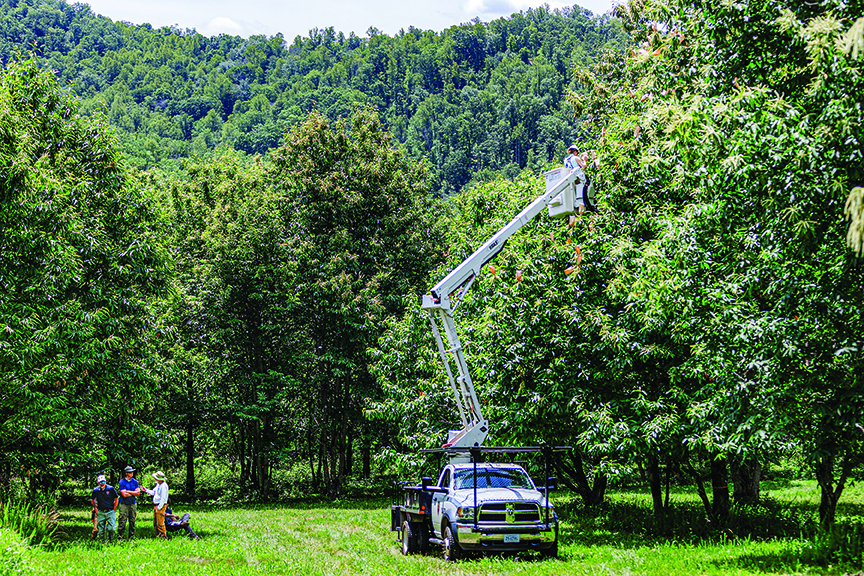
A bucket truck gives pollination workers necessary access to the higher reaches of the American chestnut trees. (Radiant Snapshots photo)
by Amanda S. Creasey, Outdoors Writer

John Scrivani
When I arrive at the chestnut orchard in Lesesne State Forest, one tree immediately arrests my attention. With lush blooms, healthy foliage and symmetrical branches, she stands tall and proud amid the pastoral scene. Later, I will learn this stunning beauty has a name: Gladys. Referring to her as female, though, isn’t exactly accurate.
John Scrivani, chair of restoration science for The American Chestnut Foundation, explains that chestnuts are monoecious, producing both male and female flowers. He gently pulls a low branch lower, allowing me to inspect its flowers. The male blossoms, catkins, look like furry fireworks, the female flowers like tiny, upside-down pineapples.
Scrivani leads me toward a utility truck, its bucket extended so the woman perched inside can reach the canopy of another impressive chestnut. Central Virginia Electric Cooperative has donated bucket truck services in the past, when the Virginia Department of Forestry trucks are unavailable, he tells me. Cassie Stark, director of science implementation for TACF, is poised in the bucket, hand-pollinating the tree. After a few minutes, Scrivani calls up to her, the bucket is lowered and Stark hops out. I notice some linework on her forearm — a delicate chestnut leaf is tattooed there.
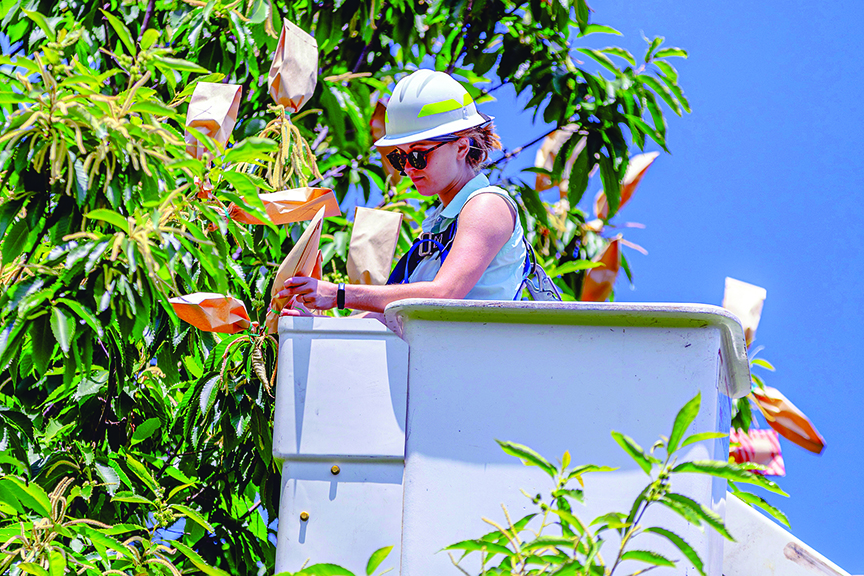
Cassie Stark, director of science implementation for The American Chestnut Foundation, hand pollinates a chestnut tree.
A SCIENCE OF PATIENCE
 From Stark, I learn TACF is breeding Asiatic disease-resistant chestnut trees with American chestnut trees. The resulting offspring will be hybrid chestnuts with varying levels of disease resistance inherited from Chinese and Japanese chestnut, an important trait for competing in a forested setting.
The hand pollination happening in the orchard today is not a long-term solution to the American chestnut’s struggle to survive, but a bridge to hopeful restoration. The process currently in use is an industry standard known as recurrent genomic selection. Stark explains that researchers breed high-performing trees and then breed their offspring in subsequent generations, gradually strengthening selected traits.
It’s a slow process. Scrivani laughs as he says, “We’re always reminding ourselves that we work on tree time, generation by generation. Our progress can take 10 to 15 years to evaluate. The department of forestry has been working on restoration for 40 years.”
Hand pollination is a key part of the process, allowing the team of staff and volunteers here today to make the correct crosses. To control pollination, volunteers and TACF staff cover female flowers with paper bags in early June before they become receptive, preventing unwanted pollen from reaching them. Once the flowers are ready, pollen from the selected tree is applied and the bags are replaced to prevent contamination. They return in the fall to remove the bags and harvest the seeds, only then learning how successful the crosses were.
Stark and Scrivani introduce me to a squad of volunteers in the orchard today to help. Among them are David Crouch, Neal Grandy and Laura Podyma, all retirees, as well as Carter Newsome, a recent college graduate. The team spans several generations. Gathered in this orchard are people ranging from a 20-something college graduate to those in the prime of their careers and those who have been retired for decades — all brought together by a common interest: one remarkable tree.
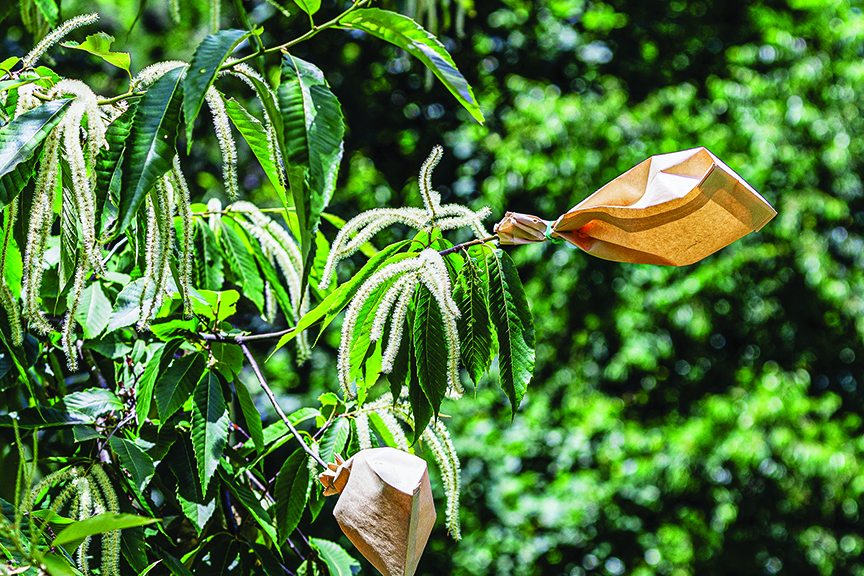
Bags cover the female flowers of a chestnut tree to control pollination.
MORE THAN A TREE
What’s so special about the American chestnut? A lot, it turns out.
Before the blight, the American chestnut was an important source of food and income throughout Appalachia, explains Zoe Bergman, Virginia Department of Forestry research program manager. Long before European settlers arrived, Native Americans relied on the tree for nuts, wood, tanning bark, shelter and wildlife habitat.
Though less mainstream than it once was, the chestnut remains a food source today. Bergman says its texture differs from walnuts and pecans, while Stark describes its flavor as sweet and earthy. Raw chestnuts are mildly flavored and somewhat starchy, Scrivani says, but roasting brings out their sweetness and nuttiness.
The chestnut was also ecologically important. As a foundational species in oak-chestnut forests, it helped shape forest structure and nutrient cycling while providing a reliable food source for wildlife. “[They were] a fast-growing, high-yield tree that produced nuts for bear, turkey, deer and songbirds alike,” Bergman says. Their rapidly decomposing leaves contributed to soil fertility, while their rot-resistant wood stored signi ficant amounts of carbon. Their greater combustibility also encouraged lighter understory fires, helping prevent more devastating canopy fires.
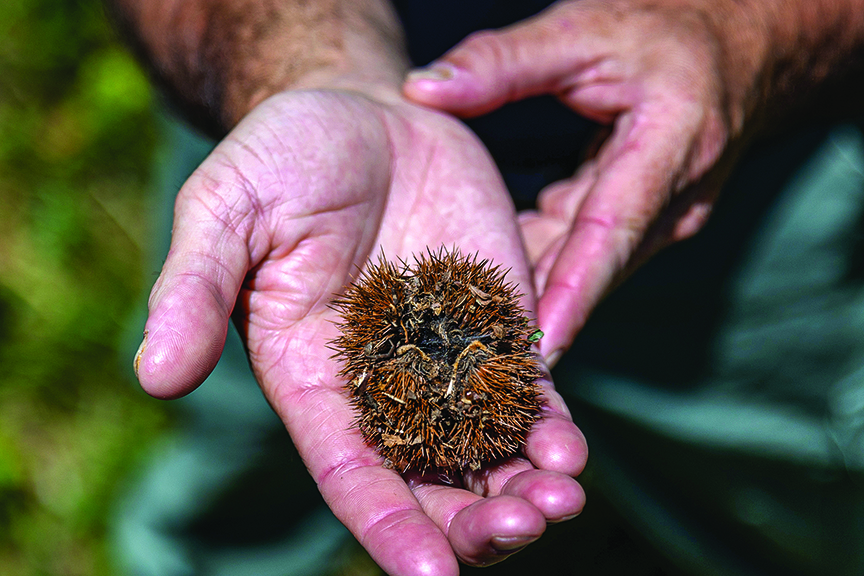
An empty chestnut burr
A FRIENDSHIP TAKES ROOT
Bergman values the trees on a personal level, too. They provided the foundation for her friendship with Stark. Bergman refers to the American chestnut as the friends’ “gateway tree.” Bergman and Stark first worked together as young researchers studying hybrid American chestnut restoration at James Madison University under Dr. Heather Griscom. They spent hundreds of hours in the West Virginia mountains measuring chestnut seedlings and became lifelong friends.
Today, they have matching American chestnut tattoos, and Bergman was a bridesmaid in Stark’s wedding. “I love her dearly and truly have the American chestnut to thank for introducing us,” Bergman says.
The orchards in Lesesne offer some of the oldest and largest trees TACF uses in collaboration with DOF as a part of its breeding program. The state forest boasts a 58-year-old, 10-acre, closed-canopy stand of hybrid American chestnuts, possibly the only one in the U.S., according to Scrivani.
“Lesesne is more than a stand of beautiful trees. It is a living bridge between decades of breeding, public forestry, volunteer commitment and modern genomic science, and it shows us what the future of the American chestnut could be,” says Michael Goergen, president and CEO of TACF. Visitors are asked to be respectful, refrain from removing any flagging and avoid marking any trees.
Podyma, drawn to volunteer in the chestnut orchards by a childhood fascination with the trees, says the plentiful chestnut carcasses in the woods were always “a point of curiosity” for her.
Prior to the blight, an estimated 4 billion American chestnut trees thrived in the U.S., though that figure is not well documented, and perhaps 25% of timber came from American chestnuts. Today, an estimated 300 to 400 million wild American chestnuts remain in the U.S. By comparison, a similar tree, the tulip poplar, numbers around 1.5 billion. If restoration efforts succeed, a generation or two from now, more than chestnut carcasses will populate the woods. Majestic, healthy trees like Gladys may once again lift their branches high into the forest canopy.
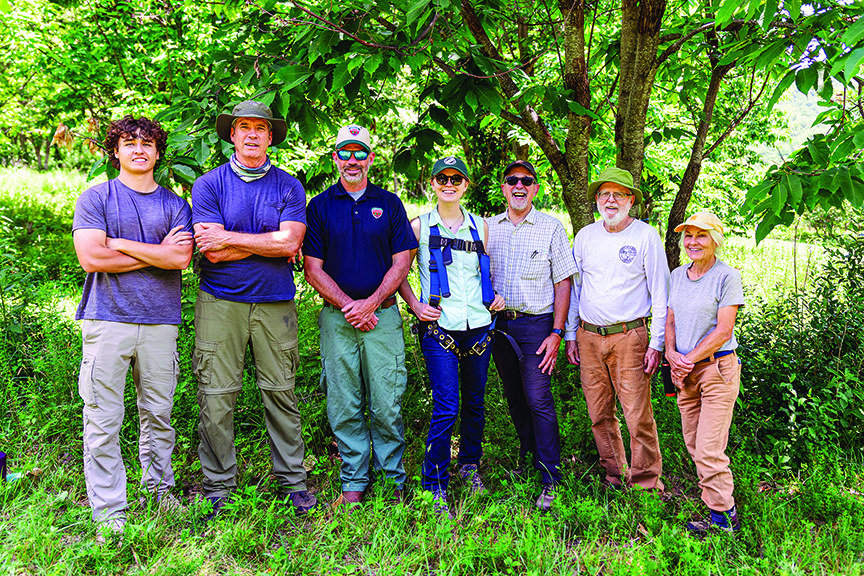
The June pollination project team, from left: Carter Newsome, David Crouch, Jack Kauffman, Cassie Stark, John Scrivani, Neal Grandy and Laura Podyma