
July 2026
story and artwork by Anne M. Dellinger, Contributing Columnist
As America observes its 250th birthday, there is much to remember and celebrate about our nation’s independence.
There will be parades and fireworks.
Famous Revolutionary War battles and historic uprisings will be reenacted.
The heroic deeds of well-known patriots will be reviewed and honored.

And while most of the focus will be centered on the war’s big names and their legendary accomplishments, it will be equally important to remember and respect the Revolution’s numerous unsung heroes, especially the farmers and their families.
Many men were farmer-soldiers who served part time in the militia. When they were away fighting, their wives and children were responsible for managing all the farm duties in addition to the daily household chores.
These hardworking farm families gave much of their time, goods and energy to the war effort.
Their countless contributions from the farm to the battlefield became the lifeline that the colonists needed to prevail over the British military.
It’s understandable that these homefront heroes deserve to share some of the limelight during the country’s celebrations.
As a child of modern times, you might find it difficult to imagine growing up on a farm during the turbulent Revolutionary War years and having to take on adult responsibilities.
However, if you are curious about comparing your lifestyle with that of children in the 1700s, then imagine stepping back in time by picturing yourself going inside one of their homes and taking a brief survey of your findings. (The photo below is from the Whickham House Museum in Woodstock, Va.)
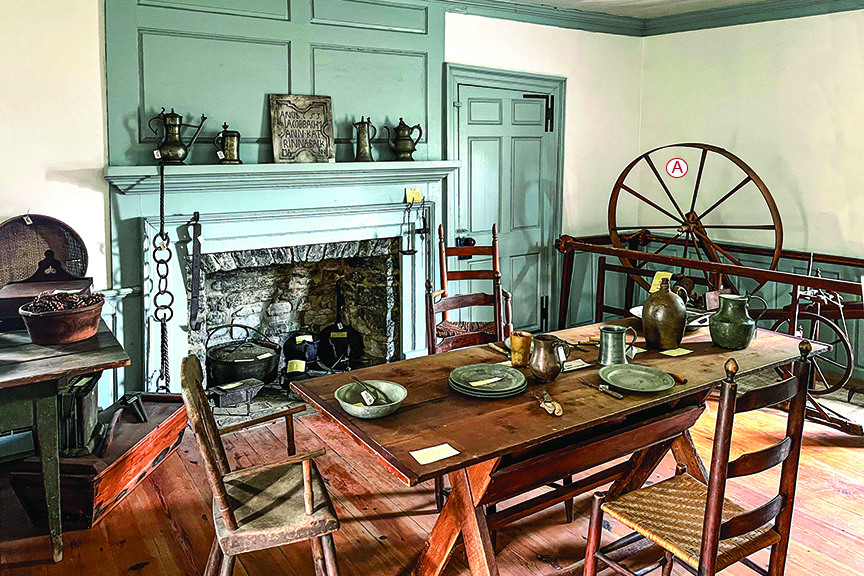
Welcome to the kitchen area. When compared to your own family’s kitchen, what basic conveniences are missing here?
- Girls in the family began cooking between ages 6 and 10 over an open hearth. What foods do you think they cooked in the big, black pots in the fireplace?
- They also had to learn to churn butter, knead dough, make candles and soap, and help with cleaning. Which of these jobs do you know how to do?
- Managing the fire for warmth and cooking was a daily chore done mostly by the boys. If this had been your job, what steps would you have followed to keep the fire going?
- Most families made their own clothing. Girls learned to use a device that created yarn from sheep wool or linen from flax to be used for weaving. Can you identify this important machine, marked by the letter A in the photo above?
- Have you ever sewed a button on a shirt or completed a sewing project?
- Children were also expected to perform outdoor chores such as fetching water from wells, gardening, gathering eggs and taking care of the livestock. Which of these chores have you done?
These rigorous daily chores were crucial to a family’s survival in the 1700s. It was a time when learning practical life skills was considered more important than acquiring an academic education. While most children learned to read and write, they often had to quit school between ages 8 and 10 to begin working as “miniature adults” alongside parents.
Even though it sounds like a life of all work and no play, children of the past learned to balance their hard chores with outdoor fun. They found time to fish, swim, fly kites and play games of marbles, hoop and stick, and blind man’s bluff.
As you envision stepping out of the picture and back into 2026, perhaps you now have a greater appreciation for the time and energy given by the dads, moms and children who “kept the home fires burning” while supporting the Revolution.
This is the year we all need to pause and be grateful for our strong-minded, gritty ancestors — those who bravely fought on the battlefields and those who stayed behind, carrying out the everyday routines that actively supported the cause. Their heroic actions and sacrifices contributed greatly to the freedom and independence that every American cherishes today. Perhaps everyone should say thank you at least 250 times on July 4 — maybe while the fireworks are bursting in air!
SUPER SLEUTH CORNER
During the Revolution, a particular type of hat was worn by the Continental Army soldiers and famous figures such as George Washington and Thomas Jefferson. It was designed with three corners that helped rain slide off of the hat and onto the shoulders while keeping the face dry.
Owlbert would like for you to find a picture of this hat hidden in the July 2026 issue of Cooperative Living magazine. Follow the directions below and then submit your findings for a chance to win a $25 Amazon email gift card.
- Find the hat and give the page number.
- What is the name of this hat?
- Have you ever seen this hat worn in a Revolutionary War reenactment?
Submit your answers below, at co-opliving.com/super-sleuth. or send answers with your name, address and phone number to:
Cooperative Living Super Sleuths
4201 Dominion Blvd., Suite 101
Glen Allen, VA 23060
Kids Korner submissions are for children under the age of 16.
MAY SUPER SLEUTH WINNER
The May Super Sleuth was about bees, pollination and protecting vital pollinators. For a chance to win a $25 Amazon email gift card, kids were asked to find a picture of a bee colony hidden in the magazine and then provide the page number it was hidden on. They were also asked to identify what the cluster of bees is called, share whether they’ve ever seen a huge collection of bees and then say what they could do to protect a huge mass of bees from harm if encountered.

- Page 35.
- A swarm.
- “Yes, at my friend’s house. Her dad is a beekeeper.”
- “Let it be. Warn people to stay away from it.”
OUR WINNER IS KARA.
Congratulations, Kara!
Northern Virginia Electric Cooperative member