
A belle of the ball in springtime, the fringe tree faces unwelcome suitors
May 2026
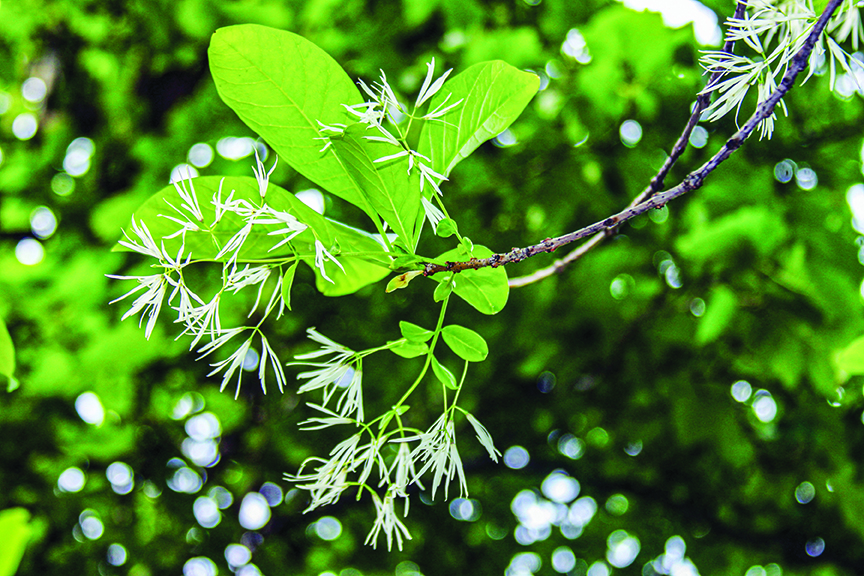
Fringe tree flowers (courtesy Melissa McMasters via Flickr)
by Steve Carroll, Contributing Columnist
White fringe tree (Chionanthus virginicus) is one of our region’s most beautiful yet under-appreciated small trees. Its fragrant, white flowers open as the leaves emerge, providing an opportunity for it to steal the show from other spring-flowering trees. Nature writer Donald Culross Peattie called it “a raving beauty.” Fringe tree flowers also typically open late enough in spring to avoid frost damage. Despite these benefits, you may be wise to avoid planting this tree. It’s better to appreciate specimens growing along streets, in nearby parks or in neighbors’ yards. But more on that later.
Fringe tree can grow as a large shrub or a small tree (12 to 20 feet tall and wide, or more) and does best in full sun to partial shade. It is a native species from New Jersey to northern Florida, and from eastern Oklahoma westward into Texas, but it is often planted successfully outside this range.
The creamy-white flowers have four strap-like petals and hang in clusters. Plants are typically either male or female, with male flowers slightly larger than female flowers. If female flowers are successfully fertilized, small, blue, olive-shaped fruits develop. And speaking of olives, fringe tree — such as ash and a few other species — are among the few North American native trees in the olive family.
Leaves emerge and expand in late spring. They grow in pairs along the stem; have smooth, untoothed margins; and are 4 to 8 inches long and 2 to 3 inches wide. In the fall, leaves may turn yellow-green to golden yellow, although this tree does not reliably display spectacular fall color.
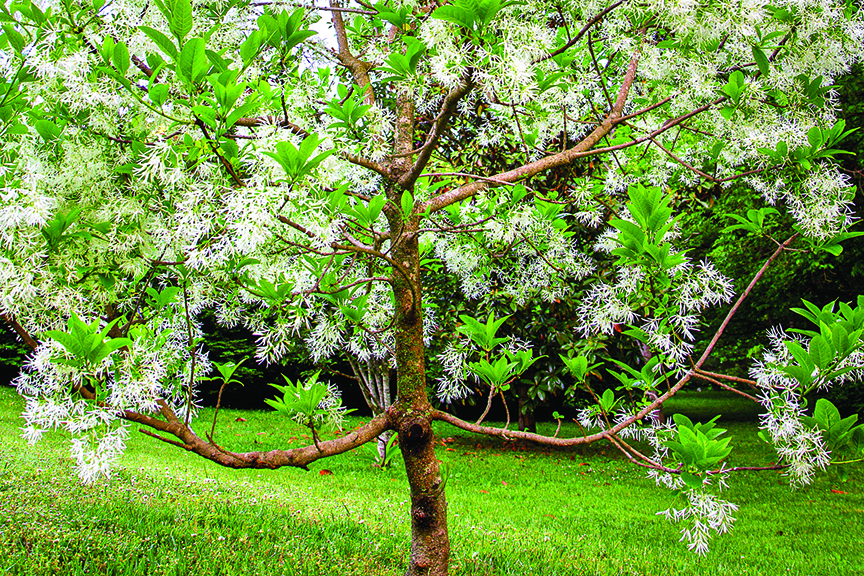
The fringe tree’s leaves emerge and expand in the late spring. (courtesy Arthur T. LaBar via Flickr)
Fringe tree plays a number of important roles in the functioning of natural ecosystems. Bees, butterflies and hummingbirds visit flowers to feed on nectar and gather pollen. Deer, turkey, quail and many songbirds eat the fruits, and the leaves are eaten by a variety of caterpillars. Native Americans have traditionally used fringe tree as medicine by drying the roots and bark to treat skin inflammations, and by crushing the bark to treat sores and wounds.
In nature, fringe tree grows in many different habitats, including stream edges, floodplains, dry upland woods and rocky outcrops.
So, here we have a tree with lovely, aromatic flowers; one that opens its flowers late enough in the season to dodge most spring frosts; a species that can be pruned to grow either as a multitrunk shrub or a single-trunk tree; and one that tolerates a wide variety of soil and site conditions. Why, then, should we not plant this tree more often? Three words: emerald ash borer.
Emerald ash borer is an introduced wood-boring beetle that feeds on the bark of susceptible trees, forming galleries (interconnected tunnel systems) underneath the outer layer. In the U.S., they were first detected in Michigan in 2002, according to the U.S. Forest Service.
I wrote of emerald ash borer’s devastating impact on our ash trees — killing tens of millions of trees — in the June 2022 issue of this magazine. More recently, scientists have found that fringe tree is also susceptible to emerald ash borers, a discovery that may not bode well for this beautiful tree’s future.
So, what to do? For now, it may be best not to plant fringe trees on our properties or in our public spaces. Instead, seek them out in the wild, or where they have been previously planted, especially in late spring, and soak in their rich fragrance and remarkable beauty.
Steve Carroll is a botanist and ecologist who writes about trees, gardening and the world of plants. He is the co-author of “Ecology for Gardeners,” published by Timber Press.