
American hazelnut proves ecological importance doesn’t always come with flash
March 2026
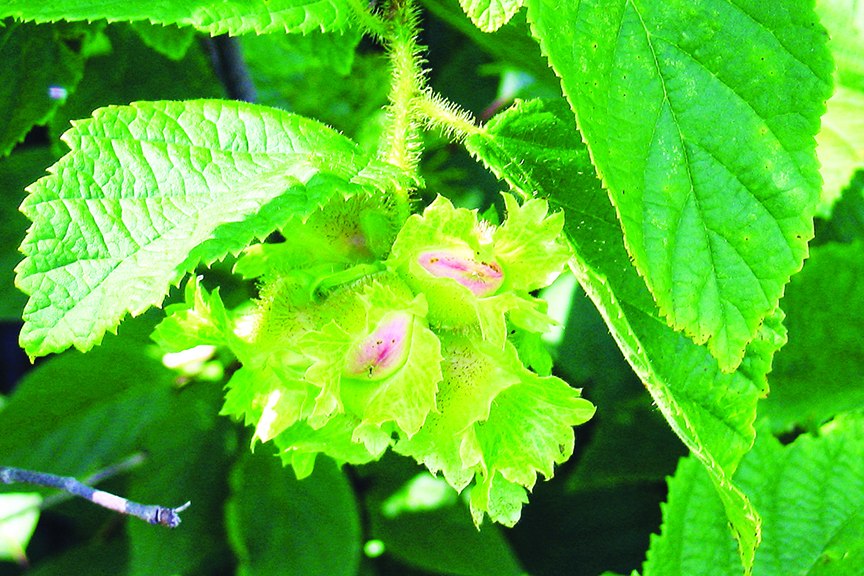
Leaves and developing hazelnut fruits (courtesy Superior National Forest via Flickr)
by Steve Carroll, Contributing Columnist
Tree watchers eager for spring’s arrival often anticipate the blooms of redbuds, dogwoods and magnolias. Fair enough — these trees offer a dramatic and welcome display. But those willing to lower their gaze may be surprised by one of the season’s earliest, and most easily overlooked, blooms: the American hazelnut. Hazelnut, a midsize shrub native to much of the eastern U.S., produces separate male and female flowers on the same tree. Male flowers develop in 1- to 3-inch catkins that hang near the tips of branches. Female flowers are smaller, but if you look closely, you will see their distinctive red styles and stigmas, where wind-blown pollen from male flowers collects.
American hazelnut (Corylus americana), also called American filbert, is a member of the birch family. In our region, this small plant family includes about a dozen species, including birches, alders, ironwood and hophornbeam. American hazelnut grows in USDA cold hardiness zones 4-8. It prefers moist to dry upland forests, well-drained floodplains and old fields, but it does not tolerate standing water. In our region it is common in the mountains, Piedmont and inner coastal plain and uncommon along the outer coast.
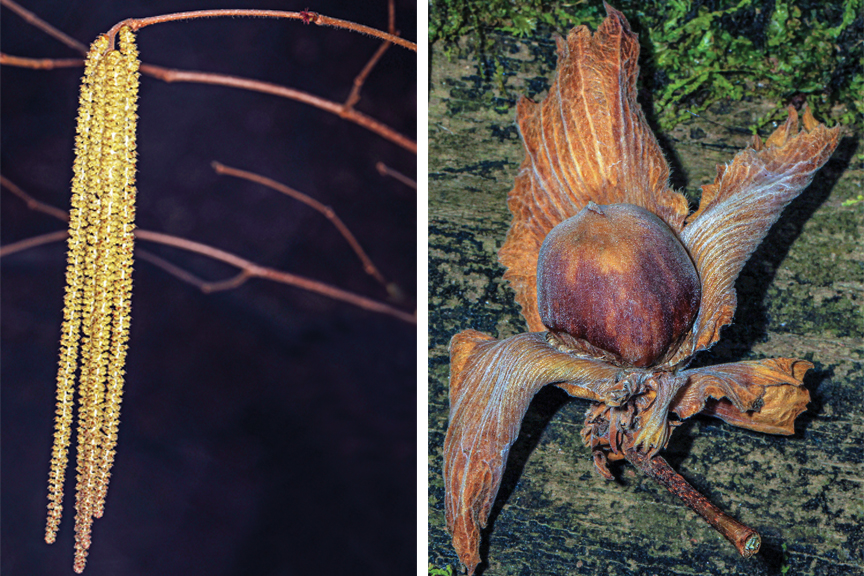
Male hazelnut catkins at left; a mature hazelnut at right (photos courtesy Judy Gallagher via Flickr)
The hazelnut shrub typically reaches 12 to 18 feet tall, with multiple stems growing from its roots and underground rhizomes. It tolerates shade, but flowering and fruit production increase in sunnier locations. Leaves emerge after the flowers and are simple (only a single blade per leaf ), measuring 3 to 5 inches long and 2 to 3 inches wide. They have double-toothed edges. Autumn leaf color ranges from pale yellow to yellow-green to red or purple, but the color is unpredictable and not particularly showy. Those seeking showy fall color may want to look elsewhere.
The nuts, if fertilization is successful, form within a leaflike husk with ragged edges. In fact, Corylus, the generic name, comes from the Greek word for “helmet” — a nod to the shape of the husk. Hazelnuts are an important food source for wildlife. Caterpillars of more than 125 moth and butterfly species feed on the leaves; deer, rabbits and other mammals eat the leaves and twigs; and the nuts are feasted on by grouse, quail, turkey, songbirds, squirrels and other small mammals. Truth is, if you grow hazelnuts hoping to harvest them for yourself … good luck!
Growers fortunate enough to harvest hazelnuts can eat them raw, roasted or ground into flour. They can be used in baking, added to salads, paired with seafood and chicken, and prepared in countless other ways. Even those who don’t go out of their way to eat these nuts may still have tasted them in hazelnut pralines or in the distinctive flavor of Nutella. If you do spot hazelnuts in a product on your grocer’s shelf or as an ingredient on a restaurant’s menu, ask about their source. Commercial nurseries in the U.S. grow American hazelnuts, but most hazelnuts used in food products come from closely related European and Asian species.
Hazelnut is not among the giants of our forest, nor is it a showy tree or shrub. However, as a large shrub with year-round interest that provides critical food, cover and nesting sites for a long list of birds and mammals, it is a vital component of our nation’s eastern deciduous forest.
Steve Carroll is a botanist and ecologist who writes about trees, gardening and the world of plants. He is the co-author of “Ecology for Gardeners,” published by Timber Press.