
When squirrels fight the power lines
June 2026
by Preston Knight, Contributing Writer
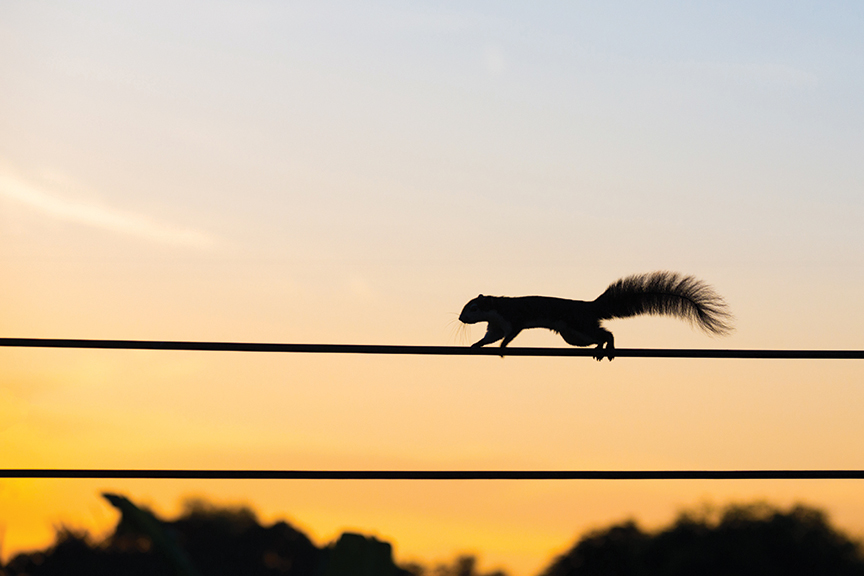
Squirrels are an electric reliability problem.
You might already know this. Believe us, electric cooperatives are fully aware. And the tree-dwelling rodents, well, they seem to lack the knowledge, whether it be from defiance, ignorance, safety or simply genetics.
“I do hear this a lot, ‘How on earth are these animals surviving as a species if they are so dumb?’” says David Mizejewski, a naturalist with the National Wildlife Federation. “They only have to survive long enough to reproduce once. … If [a squirrel] gets zapped, if they have already reproduced, then those same genes not to be wary of power lines are going to be present in the population.”
From a squirrel’s perspective, we get it. How many trips along power lines do they safely take, every day, and live to squeak about it?
It’s the occasions they do not survive that are a problem for utilities such as Shenandoah Valley Electric Cooperative and their members.
This year, outages attributed to animal contacts in the SVEC territory are greatly outpacing recent years. Through the first week of March, 73 outages were deemed from animal contact, as opposed to 37 in 2024 and just 17 in the same two-month-plus period in 2025.
When the co-op documents its outages as caused by an “animal,” the culprit could be any species. However, the majority are squirrel related, SVEC Operations Manager Martin Driver says, and this year has been worse for it.
“Why that is,” he says, “remains a mystery.”
That brings us back to the beginning. Since SVEC has built and maintained power lines for decades, shouldn’t squirrels know better by now?
“There’s evidence some animals communicate and pass down information from one generation to the next, but the dangers of electrical wires might not be part of that for squirrels,” says Ellie Tahmaseb, communications specialist for the Smithsonian’s National Zoo and Conservation Biology Institute in Front Royal. “No offense to the squirrels.”
POINT A TO POINT B
Before we explore the topic further, let’s make clear this is not an assault on squirrels. Pleasantries can be expressed.
“Gray squirrels are probably one of the few wildlife species that we have the privilege of seeing on a daily basis,” Mizejewski says, referencing the specific species found in the Shenandoah Valley.
Although squirrels tend to gnaw at whatever they encounter, exploring their opposable-thumb-less world with their mouths, the conflicts they have with power lines are mostly electrocution through phase-to-ground faults.
It never ends well for the squirrel and can leave members in the dark, sometimes on a perfect weather day. It’s a near-unavoidable circumstance.
Let the explanation — or is it blame? — fall on nature.
“These are arboreal animals. They are designed to climb up trees,” Mizejewski says. “An electrical pole to them is just another tree, and those electrical wires are pathways from point A to point B.”
Connor Gillespie, outreach coordinator for the Wildlife Center of Virginia in Waynesboro, says the natural comfort of trees plays a factor for squirrels, and utility poles and lines have simply entered their native landscape in time.
The mystery might lie more in why animal-related outages increase in a specific year, as they are currently for SVEC. One theory Mizejewski proposes makes sense on the surface: If there are more squirrels, there are more opportunities for conflict.
He says “boom cycles” for squirrel populations can occur after mast years for nut-producing trees such as oaks, which overproduce acorns as an evolutionary survival adaptation to leave a surplus beyond what animals forage.
“In years where there are so many acorns, squirrels don’t know what to do with them, and it translates to more squirrels, healthier females and better litters,” Mizejewskil says.
Squirrels have two breeding seasons, roughly late spring and then late summer/early fall, Gillespie says. Those are times when the Wildlife Center, a treat-and-release animal hospital, might see more injured and orphaned squirrels.
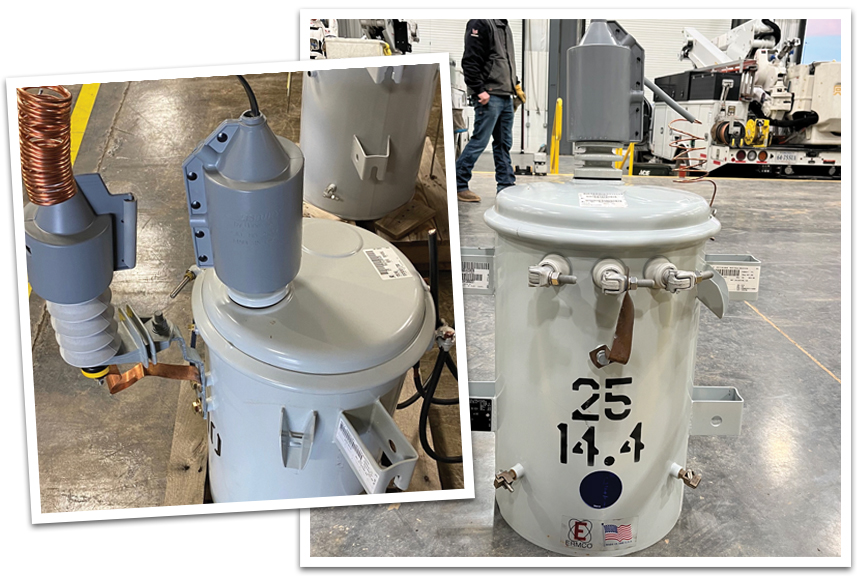
An animal guard, designed to protect the system, sits atop a transformer.
SEARCH FOR SOLUTIONS
When SVEC determines a threat to its system, the cooperative seeks to eliminate it. Trees falling into power lines, for example, are the leading cause of outages, and the answer is a variety of vegetation management solutions to rid the right-of-way of the problem. Eliminating animals is not an option. And squirrels, specifically, are pesky.
An animal guard contraption that affixes atop overhead transformers, attempting to prevent squirrels from electrocution, has mixed results.
“They do work. It is a step we take, but you can’t cover the entire system,” says Nathan Berry, SVEC’s system engineering director. “It typically doesn’t hurt anything, only helps. In general, utilities find that they end up having to cover everything up, so [that includes] an entire pole top.
“If you only cover one thing, the animals just keep moving higher and higher, particularly in a substation.”
For now, co-op members can be part of the solution. Berry suggests keeping trees, brush, and trash and debris cleaned up on property, and contacting the cooperative about trees threatening the power lines. Co-op members should not cut trees near lines, he emphasizes. “The more habitat there is and the more food there is,” he says, “the more critters there will be.”
Tahmaseb agrees, saying having trees that are not “temptingly close” to lines for squirrels may keep them away.
The goal, of course, is for utilities to find common ground with our native friends, not kick them out altogether. “Everything has a purpose. Just because something doesn’t have a purpose to us doesn’t mean it doesn’t have a purpose [at all],” Mizejewski says.
“In the case of gray squirrels, they are really ecologically important,” he says. “They are prey, an important food source for hawks, owls, foxes, snakes, coyotes. They’re sort of a protein source in that food web. But they are also incredibly important seed dispersers. It really is true that squirrels are out there planting the next generation of trees,” he says.
And, unfortunately, they are out there causing power outages. But the future might not be so bleak. Mizejewski thinks of the evolution of living with beavers, which have caused flooding issues as they jam culverts in urban areas.
“Somebody a couple decades ago came up with, basically, a beaver exclusion device that allows them to engage in their natural, instinctual dam [building], but it doesn’t clog the whole thing. Kind of a win-win,” Mizejewski says. “Maybe there will be some kind of innovation in the power industry.
“Until then, squirrels are probably something you’ll have to deal with periodically.”
 Cautionary Tails
Animal-related power outages by the numbers
According to the American Public Power Association, squirrels are the main culprits when it comes to wildlife-caused power disruptions in the U.S. But beyond the cute little rodents, animal activity involving multiple species is the third-leading cause of power outages in the nation.
Other statistics claw deeper into the problem:
- In 2023, squirrels caused 7,196 outages — more than half of all animal-related power disruptions in the U.S., according to the APWA. Birds, by comparison, caused 2,506 incidents.
- About 13 million Americans — roughly 8% of U.S. power utility customers — lose power annually due to wildlife interference with the power grid, according to The Nature Conservancy.
- The global cost of wildlife outages has been estimated at more than $10 billion a year, according to the International Network for Management and Reliability.
- In October 2020, Hubbell Power Systems reported that animal-caused electric outages led to direct and consequential damage ranging to more than $1 million per occurrence.
- The U.S. Congress Joint Economic Committee estimates power outages cost the U.S. economy around $150 billion each year.
CARNIVAL OF ANIMALS
Squirrels aren’t the only ones causing havoc. Other critters, of course, get into the power outage action across the U.S.:
- In 2024, animal-related incidents accounted for 15% of the power disruptions in North Carolina’s Edgecombe-Martin County Electric Membership Corporations’ territory. (Edgecombe-Martin County EMC)
- In May 2024, the Henpeck Substation in Franklin, Tenn., reported four power outages caused by snakes over the course of eight days. (Yahoo)
- In August 2024, a snake triggered a power outage impacting 11,700 residents in Virginia after coming in contact with a transformer. (The Economic Times)
- On March 24, 2025, a raccoon got into equipment at a substation and caused power outages for 2,541 residents in Litchfield County, Conn. (CT Insider)
- In July 2024, roughly 12,800 Rogue Valley, Ore., residents were left without power when a squirrel slipped into an Ashland power station and short-circuited breakers. (Ashland News)
- In December 2024, a roof rat got into a power substation and caused a short circuit at Rider University, resulting in a campus-wide power failure. (The Rider News)
- In April 2024, an osprey attempting to make a nest on top of a transmission line caused a power outage for thousands of residents in Hancock County, Maine, after a branch fell on the pole and caused the insulator to fail. (News Center Maine)
- In September 2024, over 4,500 Bryan, Texas, residents were left without power after doves touched two pieces of electrical equipment, causing an electrocution. (KBTX)
—Data and incidents compiled by Critter Guard Inc., inventor of utility line-protection products