
Lineworker demand challenges co-ops to feed career pipeline
June 2026
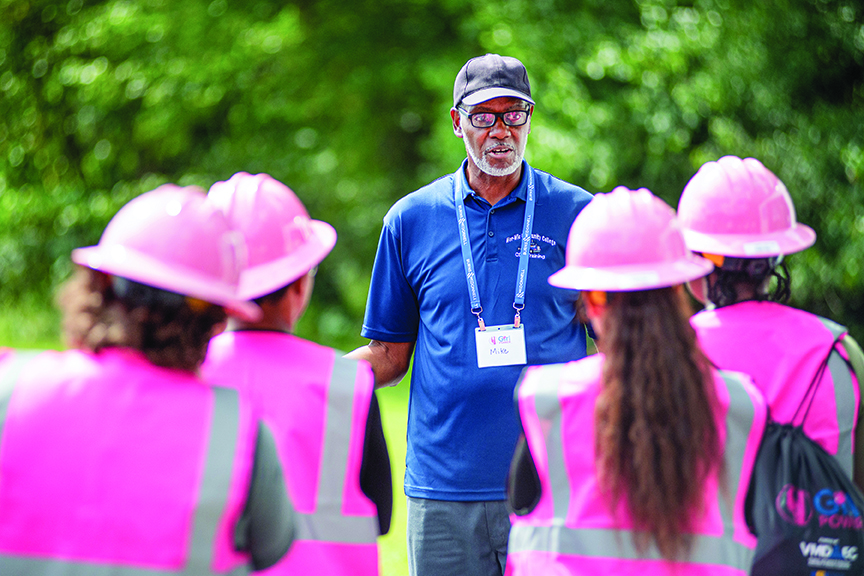
VMDAEC’s Girl Power Camp offers high school girls a one-day exploration of careers in line work. (VMDAEC photo)
by Chris Dovi, Contributing Writer
Demand for power line workers and related trades is soaring.
From the Bureau of Labor Statistics to Goldman Sachs Research and the U.S. Department of Energy, projections point to a growing need for skilled utility workers in the years ahead.
The numbers are staggering: According to BLS, there will be 7% employment growth for power line workers from 2024 to 2034 — nearly 11,000 job openings per year for power line installers and repairers. This employment growth registers well above the average for other careers, compounded by the fact that 40% of utility workers are at retirement age already or will be by 2030.
It’s a complex issue for utilities. Retirements are outpacing the training of new skilled lineworkers as energy demands hit their highest levels worldwide. And the exit of utility workers with decades of experience leaves younger workers without seasoned mentors.
Mike Costley, an adjunct instructor for Southside Virginia Community College’s Power Line Worker Training School in Blackstone, Va., retired in 2019 after 27 years as a Dominion Energy lineman. “When I retired, the average age of a lineman was about 45 to 50 years across the country,” he says. “Today the average age is about a decade younger.”
The workforce trend puts pressure on large utility companies and rural electric cooperatives alike. But co-ops face additional challenges. The co-ops’ rural locations can make it harder to recruit skilled workers to relocate to those areas. And investor-owned utility companies can lure co-op workers away with salary and benefit incentives. Yet the Virginia, Maryland & Delaware Association of Electric Cooperatives and its member co-ops have created strategies to showcase utility jobs for any career-focused audience.
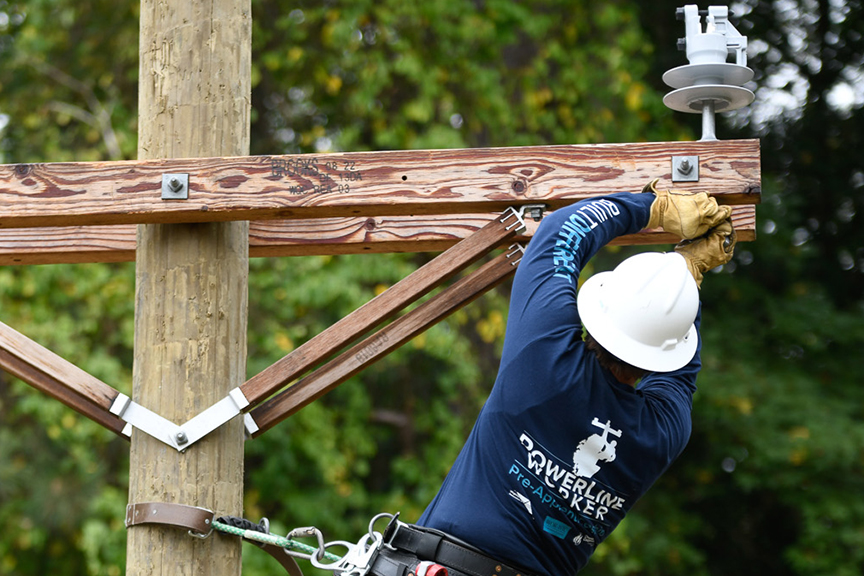
Pre-apprenticeship programs are on the rise. (VMDAEC photo)
Drawing interest among high schoolers is a key tactic, says Katie Luckett, director of marketing, communications and education at Maryland’s Choptank Electric Cooperative.
“We host many tours here at Choptank for high school students interested in utility linework,” Luckett says. “We show them the equipment, materials, bucket trucks, climbing demonstrations, the outside of a substation. … It’s as close as the students will get to real linework without being up in a bucket or dealing with dangerous equipment.”
If students can’t get to the co-op, the co-op will take demonstrations to them, she adds.
Interactive events and programs across co-ops engage students to learn by doing. VMDAEC’s Girl Power Camp empowers young women and introduces them to utility careers. Events at the association’s training facilities in Palmyra, Va., and Salisbury, Md., get the young women geared up and active in simulating basic skills of the trade. Some Girl Power participants have transitioned from pre-apprenticeship training into full-fledged co-op careers.
Co-ops such as Community Electric Cooperative and Shenandoah Valley Electric Cooperative offer a half-day session for high schoolers called A Day in the Life of a Lineman, allowing them to meet professional lineworkers, see equipment and learn the scope of the career.
Pre-apprenticeship training programs are growing in Virginia and Maryland to channel young people into the trade, largely inspired by the SVCC program, which recently celebrated its 10th anniversary. So far, the program graduated 730 students. Keith Harkins, vice president of academic and workforce programs, says about 90% of graduates are hired directly into apprenticeships.
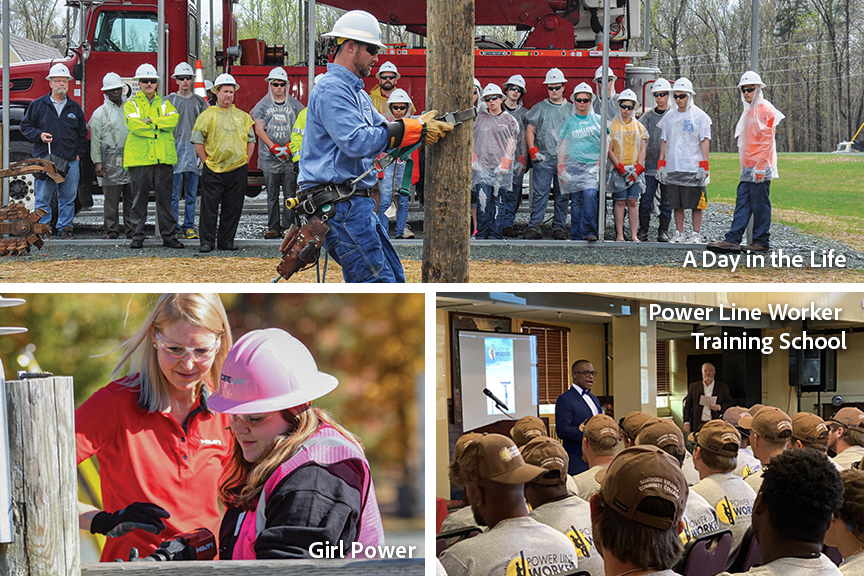
It has spawned similar programs at other community colleges — Wytheville, Mountain Empire and Laurel Ridge community colleges all now boast similar programs. Wor-Wic Community College in Salisbury, Md., began training the sixth cohort of students in its pre-apprenticeship program in May.
Years ago, says Alan Scruggs, VMDAEC’s vice president of safety and training services, lineworkers were hired off the street. “It takes a good five years to bring in somebody green off the street and get them up to speed where they can actually contribute as a journeyman,” he says.
Programs like SVCC’s help identify recruits who are serious about the profession. “It weeds them out before they’re hired by a co-op or any other utility,” says Scruggs.
And with safety always the chief concern for any utility crew, there must be increased attention to preparation, says Rachael Freeman, VMDAEC director of safety training.
“More young employees are stepping into leadership roles earlier in their careers,” she says. “One way the association has tried to do our part to help address this is by offering crew leadership training.”
The training teaches workers looking to advance how to “lead across the generation gap,” she says, and how to transition from linework into positions where a worker may have to supervise former peers.
”The course has helped provide newer leaders with practical tools and guidance as they move into supervisory roles,” she says.
