
How one well-dressed bird became the star of the Thanksgiving dinner
November-December 2026
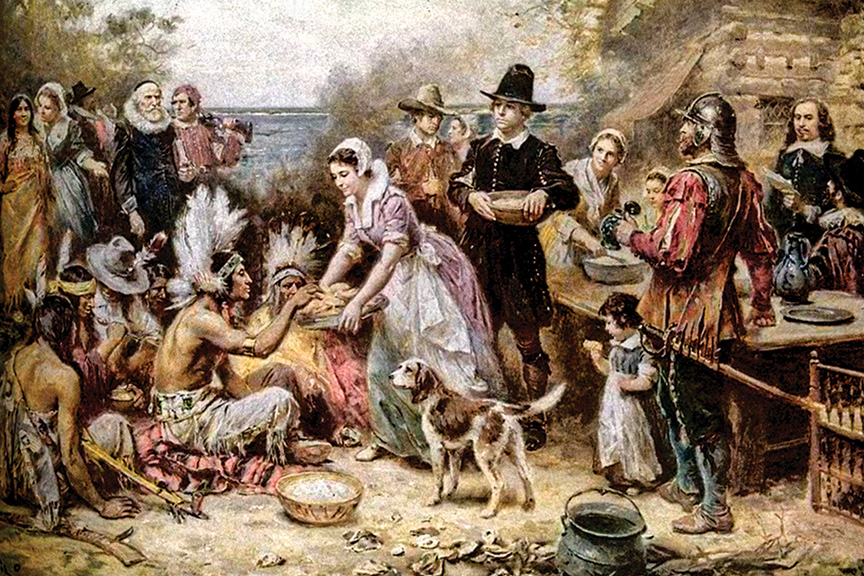
“The First Thanksgiving,” Jean Leon Gerome Ferris, 1912
by Laura Emery, Staff Writer
Every November, Americans perform a familiar ritual: We wrestle an exceptionally large bird into a roasting pan, spend hours worrying about whether it is done and then gather around the table as someone attempts to carve it with at least a little grace.
But why turkey?
For all its association with Thanksgiving, the turkey’s place of honor at the center of the table can’t necessarily be traced to that famous 1621 harvest gathering in Plymouth, Mass. According to Plimoth Patuxet Museums in Plymouth, Mass., the only surviving eyewitness account of the three-day gathering between English colonists and the Wampanoag tribe specifically mentioned just two foods: venison and wildfowl.
Turkey may well have been among the birds served. But there is no record proving it was the star of the feast. In fact, much of what seems inseparable from a traditional Thanksgiving dinner — mashed potatoes, stuffing, cranberry sauce and pumpkin pie among them — either would have been absent altogether or appeared in forms almost unrecognizable to modern diners.
So how did the turkey eventually claim the place of honor?
Part of the answer may simply be practicality. Wild turkeys were plentiful in early America, and their impressive size made them particularly well-suited to feeding a crowd. According to the Smithsonian’s National Museum of American History, colonists in the early 1600s found wild turkeys in such abundance that a dozen or more could sometimes be taken at once.
But the turkey’s transformation into the Thanksgiving bird owes at least some of its success to writer and magazine editor Sarah Josepha Hale, one of the country’s most persistent advocates for a national Thanksgiving celebration.
In 1827, Hale published “Northwood: A Tale of New England,” a novel featuring an extravagant dinner in which roasted turkey receiving top billing.
As editor of the influential Godey’s Lady’s Book, Hale spent years lobbying officials to establish an annual Thanksgiving celebration observed nationwide. By 1854, more than 30 states and U.S. territories had officially established Thanksgiving celebrations.
But Hale wanted the entire country at the table. Believing a shared holiday could unite a divided nation, Hale continued campaigning even as the Civil War raged.
In September 1863, she wrote to President Abraham Lincoln and Secretary of State William Seward advocating for a national observance. Within a week, Lincoln issued a proclamation Oct. 3, calling for Thanksgiving to be celebrated on the last Thursday of November.
Calls for a national Thanksgiving, however, predated Hale’s campaign. According to the National Archives, in 1789, Congress asked President George Washington to recommend a day of thanksgiving. Washington proclaimed Nov. 26, 1789, a day of public thanksgiving and prayer — the first Thanksgiving celebrated under the new Constitution.
Unlike Lincoln’s proclamation, Washington’s did not establish a precedent for an annual national observance. The holiday’s date remained unsettled until another president stirred up controversy.
In 1939, President Franklin D. Roosevelt moved Thanksgiving up a week to lengthen the Christmas shopping season and boost the Depression-era economy. According to History.com, many states rejected the change, dubbed “Franksgiving.” Congress eventually intervened and Roosevelt signed legislation in 1941 establishing the fourth Thursday in November as the federal Thanksgiving Day holiday.
More than four centuries after the Plymouth harvest feast, Americans may still debate the best side dish, whether cranberry sauce should come from a can and exactly how much gravy is too much. But when Thanksgiving arrives, turkey still rules the roost.