
How Christmas tree lights evolved from flickering candles to colorful, energy-saving LEDs
November-December 2026
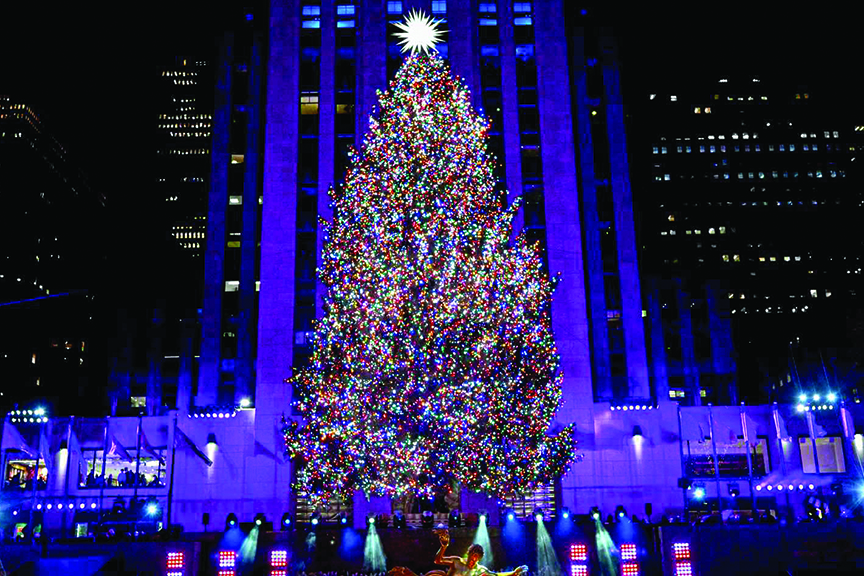
Rockefeller Center Christmas Tree, New York City, 2025
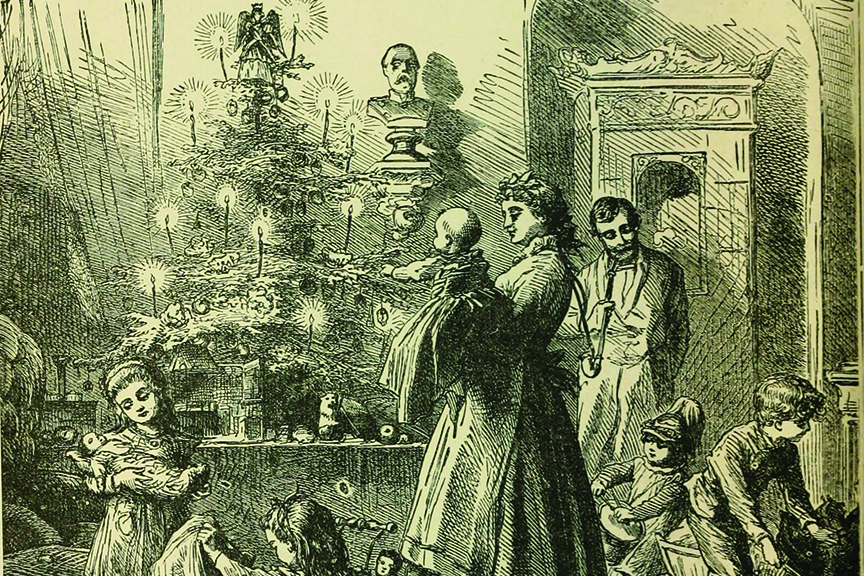
German Christmas tree book illustration, 1888
by Laura Emery, Staff Writer
The warm glow of a Christmas tree may feel timeless, but the way we illuminate its branches has undergone a remarkable transformation spanning centuries.
Long before hundreds of tiny lights could be draped across evergreen branches and illuminated with the flip of a switch, families seeking that holiday glow relied on something decidedly less convenient — and considerably more dangerous. They used wax candles.
The tradition of bringing decorated evergreen trees indoors is generally traced to 16th century Germany, according to Smithsonian Gardens, where early trees were adorned with fruits, nuts, baked goods and paper flowers. A widely repeated tradition credits Protestant reformer Martin Luther with adding candles after seeing stars twinkling through evergreen branches and attempting to recreate the sight for his family.
Whatever the precise origin, candlelit trees eventually became a cherished part of Christmas — albeit one accompanied with the very real possibility of fire. According to the Smithsonian, families took precautions that included keeping buckets of water nearby, using fresh trees and sometimes lighting the candles only once, on Christmas Eve.
Then electricity changed everything.
According to the Library of Congress, Thomas Edison created the first strand of electric lights in 1880, displaying them outside his Menlo Park, N.J., laboratory during the Christmas season. Two years later, Edison associate Edward H. Johnson — who has been called the “Father of Electric Christmas Tree Lights” — brought the innovation indoors, hand-wiring 80 red, white and blue bulbs around a revolving majestic evergreen tree in his New York City home.
The spectacle attracted attention. According to Smithsonian magazine, a reporter saw Johnson’s tree and was impressed. “I need not tell you that the scintillating evergreen was a pretty sight,” gushed the reporter. “One can hardly imagine anything prettier!”
Pretty, however, did not mean practical.
Electricity was still unavailable in many homes and was prohibitively expensive for most families. According to Smithsonian magazine, “Early bulbs lacked screw-in sockets and required the tedious process of wiring each lamp individually, a task that few had the knowledge or time to undertake. As a result, members of high society spent as much as $300 per tree to hire electricians to install lights on their conifers and be on call in case a bulb burned out or broke.”
In 1903, General Electric began offering preassembled Christmas light kits, helping move electric illumination beyond the homes of the wealthy.
The transformation continued as electrification spread across America. Incandescent Christmas bulbs became smaller, cheaper and increasingly commonplace, eventually giving generations of families the familiar tangled strands of miniature lights pulled from boxes each December.
More than a century after Johnson illuminated his revolving tree, another lighting technology began reshaping the tradition. Light-emitting diodes, or LEDs, produce light without relying on the heated filament used in traditional incandescent bulbs. According to Energy Star, certified LED decorative light strings use approximately 70% less energy than incandescent strings. With no moving parts, filaments or glass, they are also more durable and remain cool to the touch.
Today, Christmas trees can twinkle, fade, change colors and perform elaborate sequences controlled by remotes, timers and smartphones — technological sophistication Johnson could scarcely have imagined as his 80 bulbs revolved through a New York parlor in 1882.
From candles carefully balanced among evergreen branches to LEDs requiring only a fraction of the electricity of their incandescent predecessors, the technology behind the Christmas tree has evolved dramatically. But for centuries, the purpose has remained much the same: to bring a little light into the darkest days of the year.