
Following the sounds of Virginia’s Heritage Music Trail
September 2026
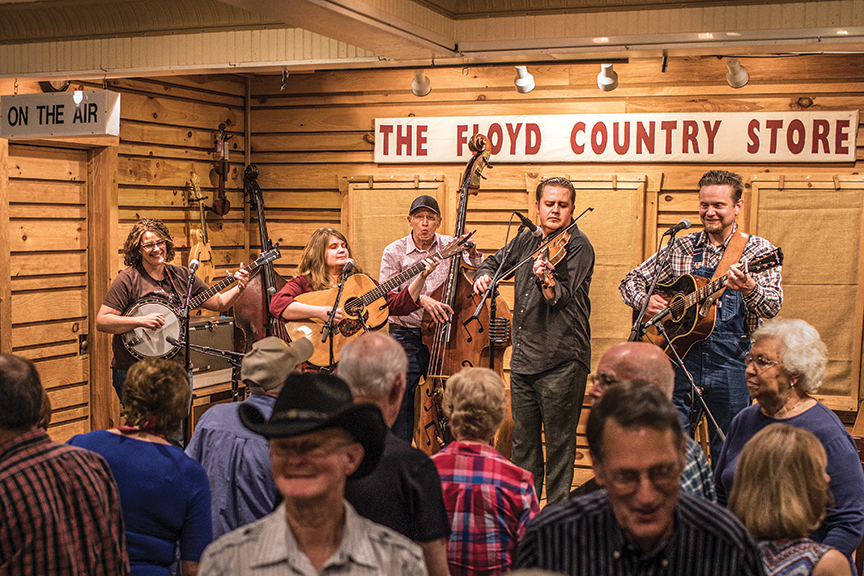
Established more than a century ago under another name, The Floyd Country Store has hosted the Friday Night Jamboree since its early days. (The Crooked Road photo)
by Don Harrison, Contributing Writer
Before The Crooked Road was established in 2004, fiddler Eddie Bond says Southwest Virginia’s musical traditions were a well-kept secret.
“There were always music events going on — square dances, festivals and jam sessions at folks’ houses,” says the National Heritage Award winner, a native of the small town of Fries, Va. Bond has played at most of the venues along the 330-mile stretch of mountainous U.S. Route 58 that forms The Crooked Road. He also hosts an affiliated jam session at the historic Fries Theater on Thursday nights. “But it was all local back then, before this,” Bond says. “We didn’t have a lot of visitors from out of state.”
A TRAIL OF TRADITIONS
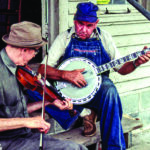
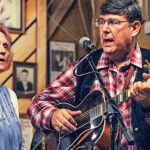
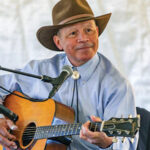
Established as an economic-development tool, The Crooked Road is a music heritage trail that winds through the mountains of the Blue Ridge, linking more than 50 destinations — concerts and jams held in country stores, museums, theaters and community halls — across 19 counties, four cities and 50 towns.
American string-band music was born and refined in this region, where nearly 100 years ago the “big bang” of country music occurred in the Virginia-Tennessee border town of Bristol. That’s where producer Ralph Peer recorded the music by Jimmie Rodgers and Virginia’s Carter Family, helping launch the commercial country music industry.
“The Crooked Road is where you can see how these traditions are being practiced and reinvented today,” says Virginia’s state folklorist Katy Clune, who runs the Virginia Folklife Program at the nonprofit Virginia Humanities. “It’s an exceptional window into local culture. From visiting the Birthplace of Country Music Museum in Bristol to checking out the old Fiddlers’ Convention in Galax, you can use The Crooked Road as a passport into these hearts of small communities in Appalachian Virginia.”
“I like to think of the trail as a thread that weaves the fabric together,” says Patti Price-Love, the director of tourism in Galax, Va., which hosts the annual Old Fiddlers’ Convention each August. “The individual venues along The Crooked Road don’t necessarily collaborate together, but we do promote each other.”

HOEDOWNS AND JAMS
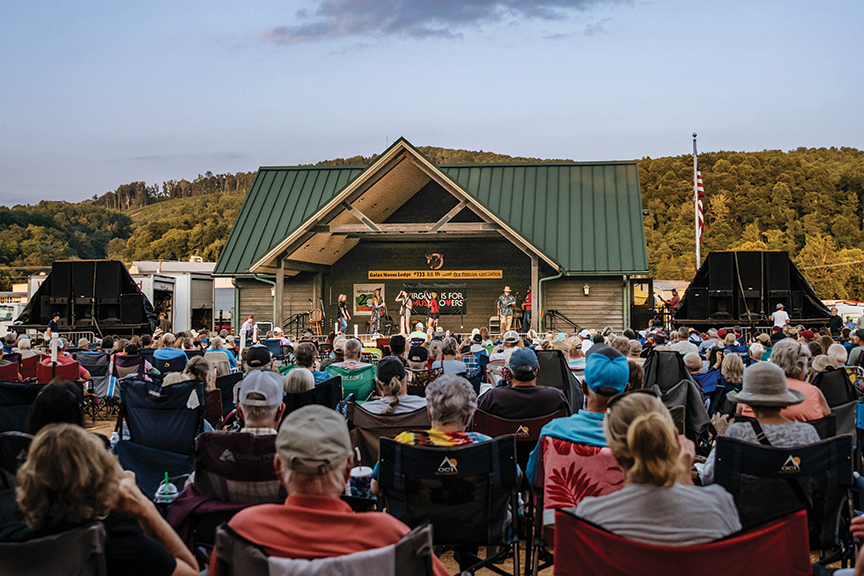
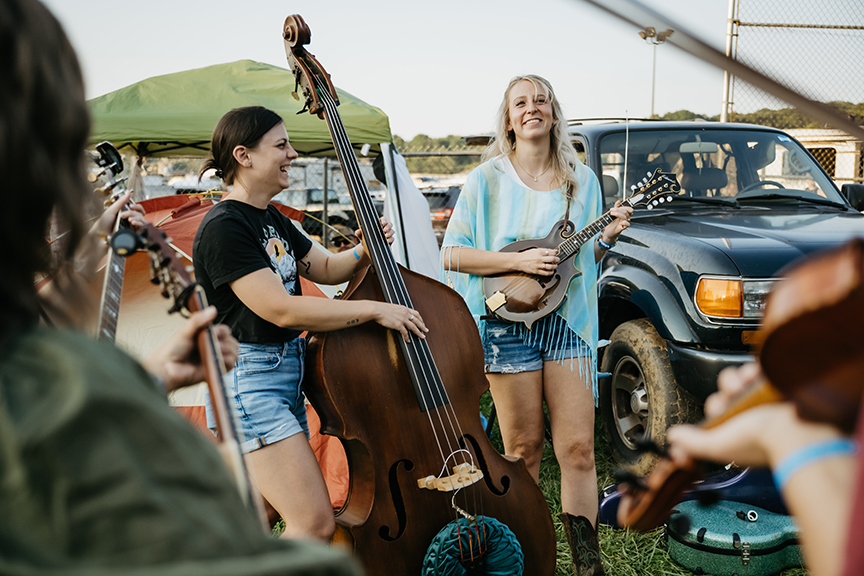
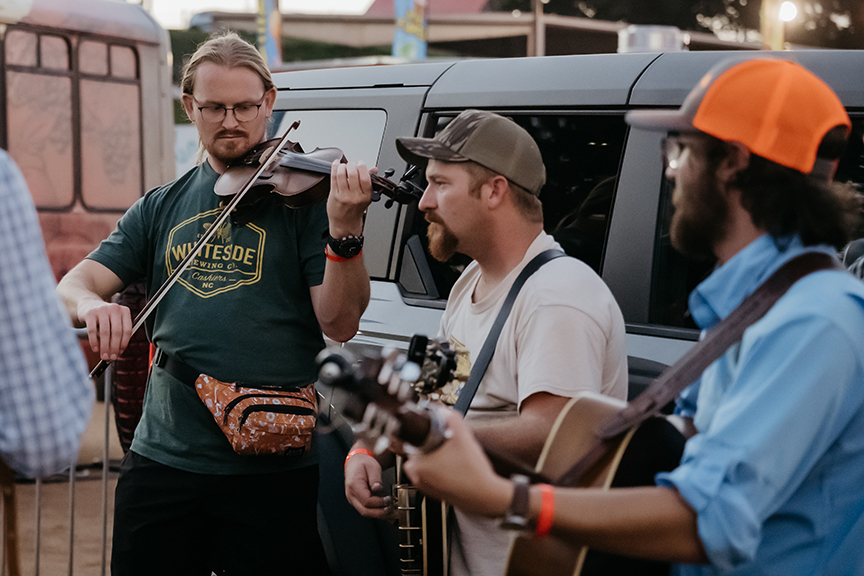
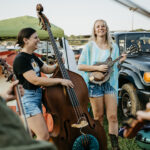
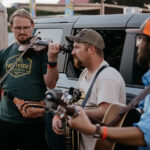
The nation’s largest, longest-running fiddling competition, the Old Fiddlers’ Convention, celebrated its 90th anniversary last month. The event is still sponsored by Moose Lodge 733. Attracting 30,000 visitors annually to Galax, population 6,000, “it’s a weeklong celebration of old-time and bluegrass [music],” Price-Love says. The Old Fiddlers’ event attracts competitors from across the U.S., as well as farther-flung locales such as France, the U.K. and Germany. “Last year we had one from Israel.”
As illustrious as it is, this hoedown, which ran Aug. 3-8, is but one attraction. There are jam sessions, performances and festivals held nearly every day somewhere along The Crooked Road in small towns such as Fancy Gap, Tazewell, Coeburn, Lambsurg, Floyd and Flat Ridge.
“We’re open every Saturday night from April to December,” says Michelle Galyean, board member of the Flat Ridge Community Center in Troutdale, Va., one of the newest affiliated stops on The Crooked Road. “A lot of people are, like, ‘Oh my lord, I can’t believe anybody lives up here,’” Galyean says with a laugh. “To get to us, you have to travel on an actual crooked country road.” The trek is worth it: For $13, you’ll get a homecooked meal, “a Sunday-after-church kind of dinner,” and a rousing evening of string-band music.
“The trail is really an all-encompassing picture of what culture is like in Southwest Virginia,” says Tyler Hughes, The Crooked Road’s executive director. “When somebody comes to visit us, no matter the venue or the festival, they’re getting a real glimpse of what life is like in Southwest Virginia. It isn’t overly commodified. It’s an authentic picture of life in the region.”
“That’s what we’re all about here, authenticity,” echoes Bethany Worley, executive director of the Blue Ridge Institute and Museum in Ferrum, Va., one of 10 major venues on The Crooked Road trail, along with 54 affiliate sites. “Everything we do, from our exhibits to our presentations and our archive [of Virginia folklife] — everything’s based on authenticity.”
LEARNING EXPERIENCES
Over the years, the institute has showcased exhibits on instrument making, moonshine, car culture and other aspects of Appalachian life. Its nearby heritage farm recreates the living and working conditions of the predominantly German settlers who came to the Blue Ridge in the early 19th century. “We have a lot of visitors who want to know what their ancestors’ lives were like,” Worley says. “We show them.”
For 52 years, the institute has presented the Blue Ridge Folklife Festival on the Ferrum College campus, featuring stages with local bluegrass, old-time, blues and African American gospel, along with traditional crafts (wooden bowls, oak baskets), food (fried apple pies, Brunswick stew), animals (horses, coonhounds), and Appalachian culture.
“Last year, we had somebody plowing with a horse, and people loved watching that,” Worley says, stressing that the focus of the festival, held on the fourth Saturday in October, is education. “Everyone has to demonstrate how they make the food, how they do the crafts. We hope that this will inspire people to keep these traditions alive.” It’s a real problem, it turns out. Many of the practitioners behind the crafts, customs and foodstuffs are aging out. “Thankfully, the music is flourishing,” she says. “It’s alive and well thanks to the Junior Appalachian Music program.”
The Crooked Road has been a blessing to the region, says clawhammer banjo master and flatfoot dancer Brett Morris. She remembers that in the early days of the road, there was suspicion that it was a scheme to exploit regional traditions. “But it’s been remarkable. I mean, just being able to creatively offer opportunities for people to connect has been wonderful, and they really support youth programming.”
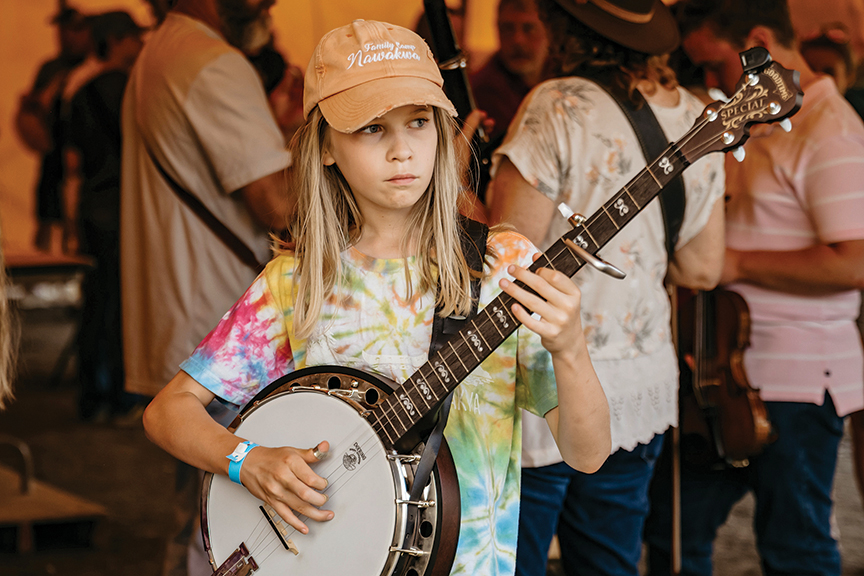
Morris, who learned the banjo from her cousin Eddie Bond, is the executive director of the nonprofit JAM. Based in Independence, Va., and originally started by guitarist Helen White, JAM oversees more than 60 after-school programs in six states, teaching children to play, dance and sing traditional old-time and bluegrass music using instruments common to the Appalachian region such as fiddle, guitar, mandolin, bass, dulcimer and banjo.
The students have numerous opportunities to perform with and learn from experienced masters (such as Bond, one of the instructors) at various The Crooked Road venues. The trail also sponsors an annual Youth Fiddlers’ Convention each August. “There was a time when I was worried about whether this music would get passed along, but not anymore,” Bond says. “I feel really good about the future of traditional Appalachian music because of JAM,” says Hughes, an experienced old-time musician.
ONE BITE AT A TIME
So how can visitors best experience The Crooked Road? Hughes says the trail is best experienced in segments rather than from beginning to end. Planning is required, and to help with that, the organization recently launched The Crooked Road mobile app.
“What we typically recommend for folks, if they’ve got the time to spend in the region, is to pick out some anchor spots to stay in and drive out of.” Hughes says that most venues are within an hour’s drive from hubs such as Bristol, Abingdon and Blacksburg. “This puts you right at the heart of some of our major stops, like the Ralph Stanley Museum, Floyd Country Store, the Carter Family Fold.”
Soon, the trail may take an off-ramp near you. “We’ve got this great program called The Crooked Road On Tour, where we take musicians from across the region and send them out across the state and the country,” Hughes says.
Eddie Bond and Brett Morris are among the stalwart musicians who play these tours. “They’re some of our best diplomats for the region,” he says. “They can get in front of an audience and play a good rousing fiddle tune and show folks that this doesn’t just have to be a one-off thing, that they can visit Southwest Virginia and experience this nearly every night of the week.”
For more information on The Crooked Road, visit thecrookedroadva.com.
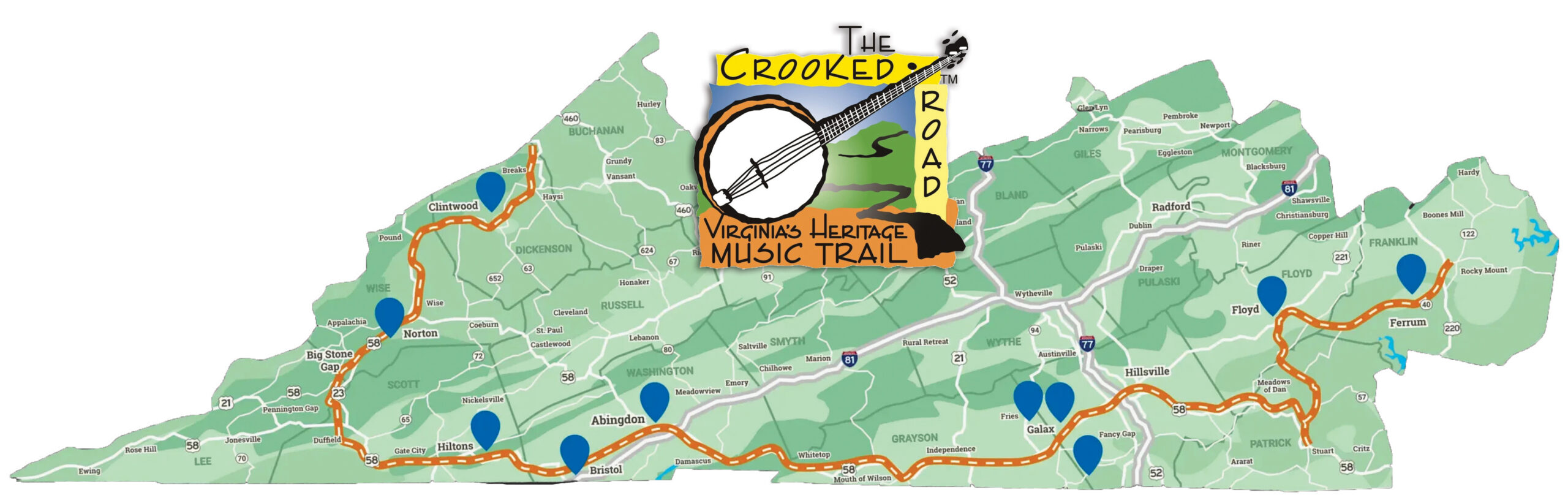
(The Crooked Road graphic)