
July 2026
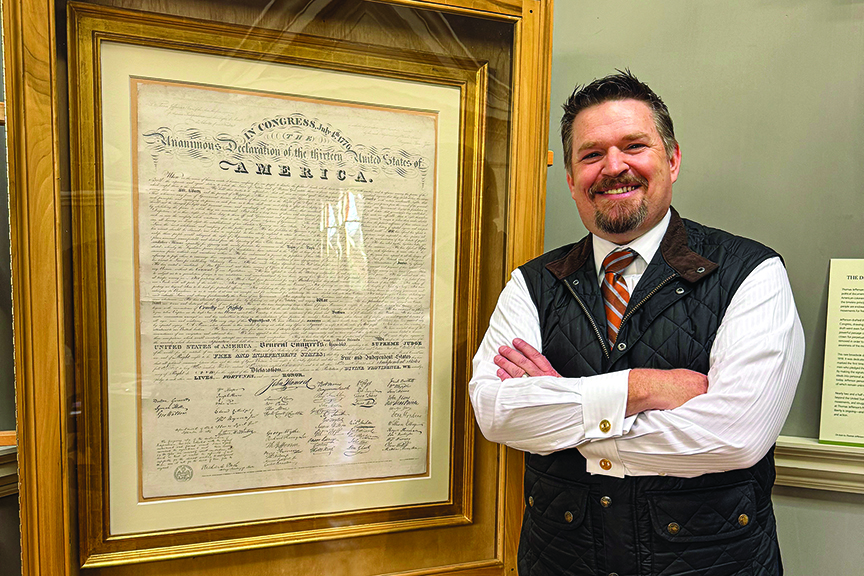
(Ben Marchi photo)
by Chris Dovi, Contributing Writer
When the time came to move an original copy of the Declaration of Independence from Virginia’s Capitol Square to a special exhibit commemorating the 250th anniversary of its signing, owner Ben Marchi couldn’t simply call FedEx. Instead, the rare document was transported through a more distinguished arrangement to its temporary home at Thomas Jefferson’s Poplar Forest, a historic site near Lynchburg, Va.
“It was cool,” says Marchi, a Poplar Forest board member. “[Virginia State] Sen. Mark Peake personally delivered it in his car to Poplar Forest.” That’s not exactly high security, but it is comparatively cheap cab fare. Marchi, who lives in Easton, Md., is a member of both Choptank Electric Cooperative in Salisbury, Md., and Rappahannock Electric Cooperative in Fredericksburg, Va., where he owns a cabin.
Poplar Forest is displaying the document as part of a special exhibit tied to the year’s 250th anniversary festivities. Marchi says he is pleased to bring his personal copy of the Declaration “home” to a place once beloved by the Virginian who drafted it in 1776. “You know, for me, personally, the Declaration of Independence is probably the most significant document in the history of mankind,” says Marchi, who acquired the rare copy about 15 years ago from a dealer in New York. “Up until we declared independence, most human beings in the world were the subject of someone; meaning they lived under a monarch or emperor or were subject to an authoritarian ruler. This represented the moment when people broke free and declared very importantly that our rights do not come from the government. But that we are endowed by our creator.”
The document has a fascinating history, says Marchi, explaining that his copy dates to 1818 — the period when many Americans first became familiar with the calligraphic version bearing the now-famous collection of signatures. Before then, most Americans would have seen what became known as the [John] Dunlap broadside, a typeset version that lacked the elegance of the handwritten parchment beyond Jefferson’s immortal words.
“Dunlap set the type, and they were printed just like a newspaper,” Marchi says. Much like Cooperative Living.
But in 1818, Benjamin Owen Tyler set out to recreate the parchment version now displayed in Washington, D.C. He painstakingly reproduced the penmanship and each of the signatures, and produced only about a thousand copies, of which, Marchi says, “only a couple hundred survive today.” Jefferson, who personally endorsed Tyler’s efforts, owned two of the copies, although both are now lost. Another copy on display at the University of Virginia once belonged to the Marquis de Lafayette.
Marchi is reluctant to share the cost of acquiring an original copy of the Declaration, though he did confirm it was “a little pricier than copies in a gift shop.”
But what the document represents, he says, is truly priceless, noting his plans to eventually place the copy in the care of a historical institution. In the meantime, he encourages people to visit Poplar Forest.
“For me, it represents the freedom of the individual,” Marchi says, calling it a statement of principles that apply to all human beings. “As imperfect as we are, it’s a perpetual guiding light up to this day for governments and movements around the world,” he says. “And that’s remarkable.” The
Related story: Virginia gave rise to a revolution, a democratic republic and eight presidents