
Contributing weather data to forecasters nationwide
June 2026
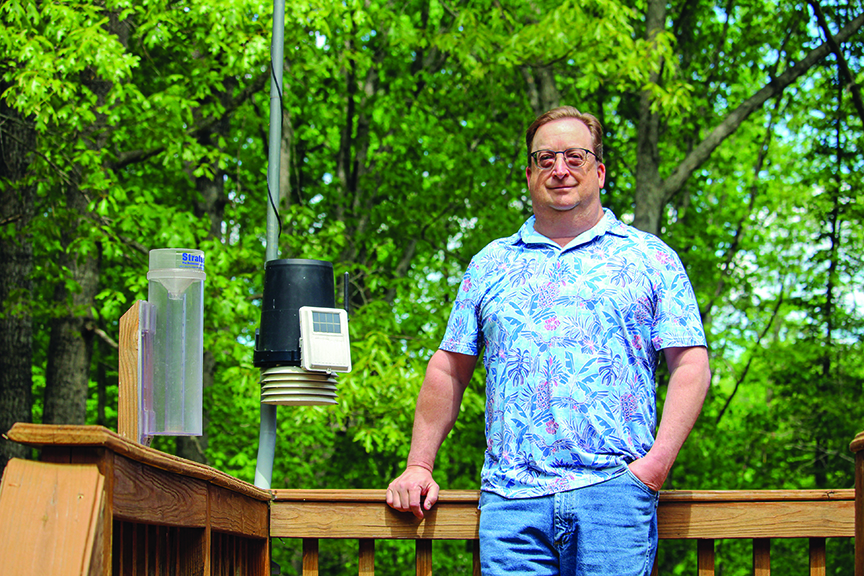
Powhatan, Va., resident Brad Blase is among a nationwide network of citizen observers helping scientists and forecasters better understand weather conditions on the ground. (Laura Emery photo)
by Laura Emery, Staff Writer
Brad Blase has a front-row seat to Mother Nature’s shifting moods.
From a small solar-powered station on the back patio of his home in Powhatan, Va., he tracks shifting winds, rising humidity, subtle swings in temperature and barometric pressure changes that hint at what may come next.
“The weather is highly variable. Even seasons, year to year, can be so different,” the Southside Electric Cooperative member says.
Blase has always been fascinated by the weather. “As a child, I had a plastic outdoor thermometer I checked every day,” he recalls.
What began as childhood curiosity has grown into a serious hobby — one that places him among a nationwide network of citizen observers helping scientists and forecasters better understand weather conditions on the ground.
A self-described “weather geek,” Blase is a professional geologist whose interest in the weather deepened years ago when he and his wife, Beth, were living in Winchester.
“In Winchester, we built a house [served by Shenandoah Valley Electric Cooperative] on the side of North Mountain, and it was very windy. I was curious about how fast the wind was blowing, so I purchased the Davis weather station I have now,” he explains.
Soon, Blase was hooked and sharing his data online. He got involved in CoCoRaHS — Community Collaborative Rain, Hail and Snow Network — a nationwide volunteer effort to collect precipitation measurements using standardized rain gauges.
“The National Weather Service spot-checks their data using citizens’ rain gauge data,” he says. “When I started with CoCoRaHS in 2005, there were only a couple thousand observers. Now, there are over 20,000.”
The instrument on Blase’s porch transmits readings to a console inside his home. That data is shared with multiple online platforms, making it available to researchers and meteorologists nationwide, including the National Weather Service.
“The data helps NWS ground-truth [compare radar estimates to ground measurements] its radar data. Thunderstorms, especially, are highly variable in rainfall. Instantaneous reports are more accurate than what radar can estimate, so it helps NWS predict where flooding may occur,” he says.
From a plastic outdoor thermometer to a sophisticated weather station, Blase is doing what he’s always done — keeping his eyes on the skies.
HOW TO START YOUR OWN BACKYARD WEATHER STATION
If you’re curious about the weather in your own backyard and have an interest in getting started as a citizen/amateur weather observer, here’s how longtime citizen weather observer Brad Blase recommends getting started.
Cooperative Living: How much would someone have to invest in acquiring a personal weather station or standardized rain gauge to start gathering data?
Brad Blase: Most affordable rain gauges are about a $100 — but they won’t last very long. I would suggest going with something a little more rugged, something that will last a long time. Some of the newer ones, I am not as familiar with. They’re about $100 to $200, but they don’t have as many replaceable parts. A semi-professional weather station is going to cost anywhere from $700 to $1,500 — but it’s something a farm or orchard would use, somebody who really wants accurate data. I tend to lean more toward expensive stuff because it usually lasts longer.
How much you need to spend also depends on what you want. If you want the full-color screen, the fanciest UV sensors, if you want to measure sunlight, if you want to measure air quality … there are so many things you can add on. You can spend a lot of money.
CL: For readers who wants to become a citizen weather observer, what websites do you recommend?
Brad Blase: I recommend AmbientWeather.com, DavisInstruments.com, WeatherUnderground.com and AcuRite.com. For purchasing equipment, you can even find home weather stations on Amazon.com. And, of course, I would love to get more people volunteering to read rain gauges, so that would be CoCoRaHS.org.
CL: What are some benefits of becoming a citizen weather observer?
Brad Blase: It’s especially nice for folks who are either retired or have kids. When you get your kids involved, they usually get excited about it too. When my kids were younger, I’d tell them to go out and check the rain gauge and they’d come in all excited, saying, “Dad! Dad! There was .07 inches of rain, or whatever.’ For retired folks, it gives you something to do each day. It’s fun and it keeps your brain active.
CL: Why is gathering citizen weather data helpful to the community?
Brad Blase: It helps meteorologists better predict the weather. But remember, we’re just collecting data. We’re not doing any predictions … just voluntarily collecting data as citizens.
HOW TO BEGIN:
Invest in a personal/home weather station: Start simple. You don’t necessarily need professional equipment right away. If you’re testing the waters to see if it’s something you enjoy and want to keep doing, try purchasing an inexpensive personal weather station — with the knowledge that you will likely have to upgrade later once you decide to commit to it long-term. For more information on purchasing a home weather station, visit wunderground.com/pws/buying-guide.
Choose the right location: Personal weather station equipment should be placed in an open area away from swimming pools, irrigated lawns, rock walls, trees and pavement, as well as sources of heat, such as chimneys, air vents or air conditioners. Placement affects accuracy. For more information on installing a personal weather station, visit wunderground.com/pws/installation-guide.
Join the Citizen Weather Observer Program: The Citizen Weather Observer Program is a private-public partnership with three main goals, according to the National Weather Service: 1) to collect weather data contributed by citizens; 2) to make the data available for weather services and homeland security; and 3) to provide feedback to the data contributors so that they have the tools to check and improve their data quality. You will need to register for a station ID, configure your software (such as WeatherDisplay, Cumulus or WeeWX) to upload data to the CWOP server. For more information on this program, visit weather.gov/cle/CWOP.
Share the data you collect/measure: Citizen observers can contribute collected weather information to national forecasting efforts by submitting data — or rainfall totals through CoCoRaHS.com — by connecting stations to platforms such as Weather Underground.