
Southside Virginia Community College marks 10 years of training prospective lineworkers
May 2026
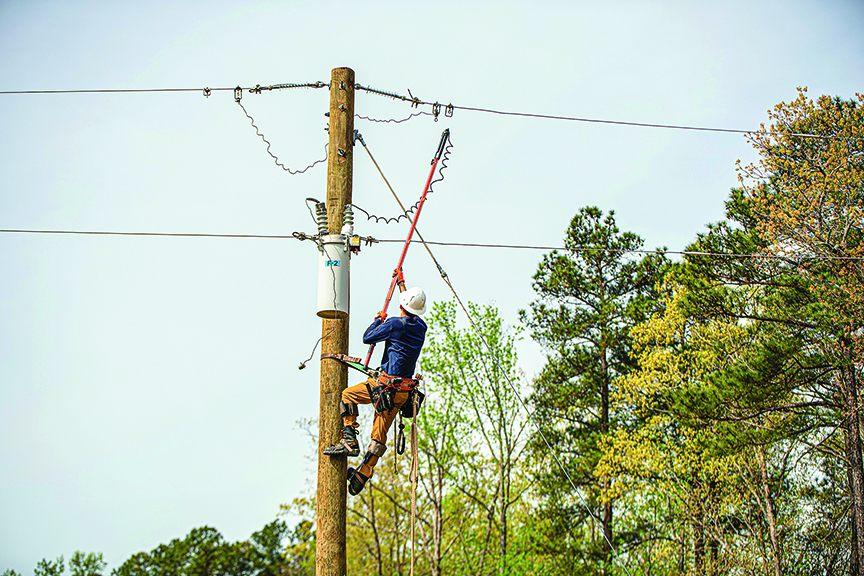
A student uses a hot stick in a training exercise that simulates working safely with energized equipment. (Photo/Jim Robertson)
by Jack Cooksey, Staff Writer

Kevin Dalton
When Southside Virginia Community College launched its Power Line Worker Training School in 2016, it didn’t just create a new workforce pipeline. It changed the direction of Kevin Dalton’s life.
Just a year earlier, the Nottoway High School graduate had planned on enrolling at the Southeast Lineman Training Center in Dade County, Ga. Dalton had his sights set on a linework career after hearing the experiences of friends already in the trade.
But the path toward apprenticeship was pricey, so the Blackstone, Va., resident took a job at ArborTech Forest Products to save up the $20,000 needed for SLTC tuition.
Then, in March 2016, Dalton encountered a lucky twist of fate. “This school opened up right around the same time I was looking to go to lineman school, and it was like perfect timing,” he says. The tuition at SVCC was a bit more than half the cost of the Georgia program. And he lived close enough to the school that he could walk to class.
“So, I signed up and went there,” he says, “and I think [there were] 11 kids in my class.”
Dalton graduated in that first cohort of SVCC’s Power Line Worker Training School, an immersion in the basic skills and knowledge needed to begin work around a power grid.
“Once I graduated from there,” he says, “I got a job … at C.W. Wright [based in Chesterfield County, Va.], and I got to travel the [country] and work storms and hurricanes in Florida.”
Five years later, he earned his journeyman card and came back to Crewe, Va., where he was hired by Southside Electric Cooperative. In November, he’ll mark five years with the co-op.
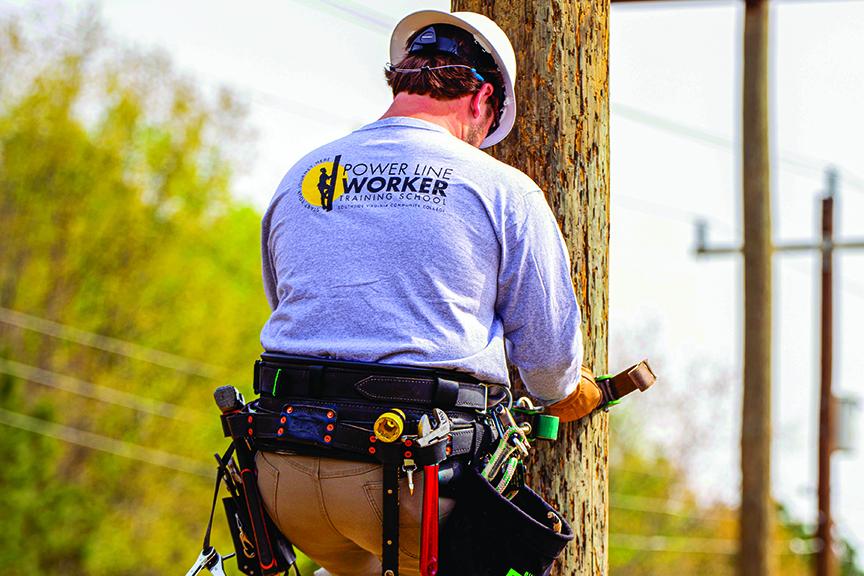
SVCC’s program offers classroom instruction as well as hands-on training. (Photo/Jim Robertson)
CAREER CONNECTION
Despite its fortunate turns, however, Dalton’s story is not uncommon to the administrators and instructors at SVCC, which is celebrating the Power Line Worker Training School’s 10th anniversary throughout 2026.
In its decade of operation, the school has awarded more than 704 associate degrees for applied science in industrial technology as of its most recent graduating class.
Keith Harkins, SVCC’s vice president of academics and workforce programs, touts the life-changing opportunities the school’s program offers both young students and older career switchers.
“The numbers are overwhelming,” Harkins says. “It’s something like 90% who get into [the program], complete it and end up with their first job as a lineworker.”

Rob Darden
Rob Darden, an apprentice lineworker with Community Electric Cooperative based in Windsor, Va., graduated from SVCC in April 2022 and didn’t miss a beat.
“I graduated on the 20th, and I started working on the 21st,” he says.
In July, Darden will complete his apprenticeship and then begin the four-year process to become a journeyman lineworker.
He says his path to linework was somewhat roundabout. During his senior year at Southampton High School in Courtland, Va., Pam Taylor of SVCC gave a presentation to students about careers in the industry, but Darden was skeptical. “I sparked up an interest in it,” he says. “You know, I thought about it.”
After two years of hodgepodge jobs, Darden says he finally stepped outside of his comfort zone. Now, as he approaches the transition from apprentice to journeyman, the income potential remains a strong motivation.
Entry-level electric cooperative lineworkers can begin at approximately $25 per hour, reaching roughly $45 per hour within four years, stepping up after each semiannual professional training course offered through the Virginia, Maryland & Delaware Association of Electric Cooperatives.
PROVING GROUND
A pre-apprenticeship program such as SVCC’s helps prove the skill and dedication of prospective lineworkers, says Alan Scruggs, VMDAEC’s vice president of training and safety services.
The SVCC Power Line Worker Training School equips its graduates with a range of skills and knowledge needed to work with electric utilities. Its linework training facility, which includes a pole yard for practical exercises, is housed at Fort Pickett in Blackstone. In addition to climbing techniques and safety awareness, students learn electrical theory and how to install, repair and maintain the hardware and support structures of utility poles. Graduates of the SVCC training program come away with five different credentials, including a commercial driver’s license, CPR and first-aid certification, VDOT Traffic Controller, NCCER Power Line Worker Level 1 and OSHA 10.
With SVCC’s tuition currently at more than $14,100, the program is more accessible than other popular schools, especially for students with limited financial resources. By comparison, SLTC’s current tuition, without room and board, weighs in at roughly $24,000.
Because the demand for utility workers is growing, various grants from state and federal funding and cooperative scholarships can lower the financial burden. VMDAEC awards $1,500 scholarships to applicants who demonstrate financial need in addition to academic achievement. Since 2003, the association has awarded more than $1.4 million to more than 1,350 students.
Randy Crocker, coordinator of SVCC’s program, estimates he has seen more than 500 students go through the program in his seven years there.
Crocker says the community college offers three 11- week sessions per academic year with about 25 students per class, many of whom connect immediately with professional opportunities, such as Dalton and Darden.
“One contractor told me that he doesn’t even try to look for students on the street or anywhere else,” Crocker says. “He comes straight to us when he when needs a lineman. … We’ve got really good instructors, and that’s how well they think of the program.”
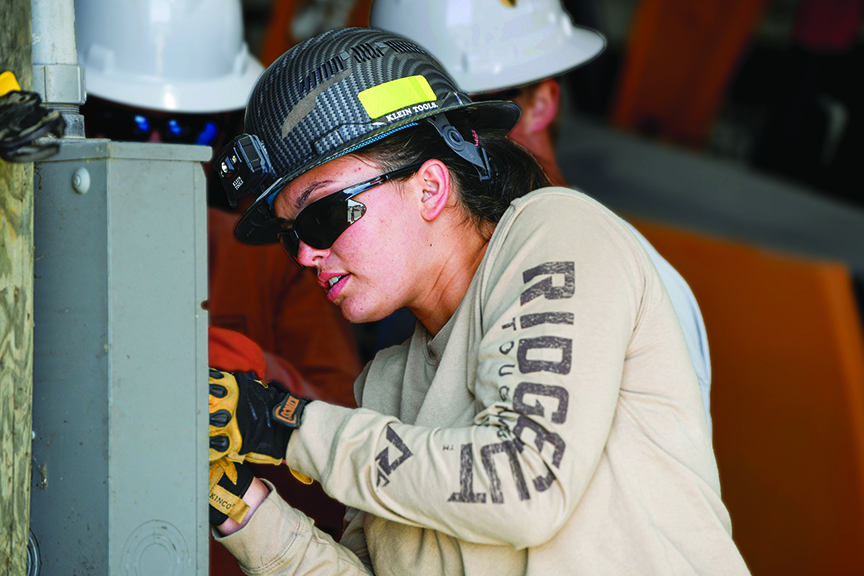
DehlilaRay Roop, three-time Girl Power camp attendee, gets hands-on experience installing an electric meter base in class at SVCC’s Power Line Worker Training School. (Photo/Jim Robertson)
KNOWLEDGE TRANSFER
The school’s three instructors all come with deep trade experience — a degree of mentorship that adds value for trainees entering a workforce that is steadily drifting toward a younger median age as workers from the Baby Boom and Generation X retire.
Mike Costley worked for Dominion Energy for 27 years as a lineman and upon retirement quickly transitioned to his adjunct teaching position for the community college, where he’s been an instructor for four years.
Costley notes that SVCC continues to improve the program’s equipment and facilities. Although energy distribution has remained largely consistent for about a century, he says, innovations and upgrades require him and his fellow instructors — Clyde Robertson and Jamie Jamerson — to stay current with changing technology, such as evolving computer systems at substations and renewable-energy developments.
Costley also notes the evolution of the trade and how the training program supports it. The current cohort of SVCC students includes DehlilaRay Roop, the second female in 10 years to enroll in the program.
Roop’s entry into linework is no fluke. Three generations of men before her have worked the trade, and when her class graduates this year, she has high hopes of working for Rappahannock Electric Cooperative, based in Fredericksburg.
“My mom is terrified,” she says, “but my dad is extremely proud.”
Despite her family connection to utility work, Roop had previously considered a career in the military or firefighting.
While at technical school, her principal suggested she attend VMDAEC’s Girl Power® Camp, a one-day introduction to linework skills and concepts. She was hooked. As a member of a cooperative service territory, Roop qualified for a $1,000 grant from the VMDAEC Education Scholarship Foundation to attend the lineworker training school.
Now, heading toward graduation from SVCC, Roop has met the challenges of the work head-on.
She recalls a hands-on exercise of assembling utility distribution poles. “Honestly, when you’re standing on the ground and looking up at all the attachments and wires,” she says, “you think, I just went up there, I took it all down and put it back up. … I just did that.”
When she graduates from SVCC this year, Roop will follow in the footsteps of Virginia’s first female lineworker, Genevie Boarman, also the daughter of a lineworker. Boarman graduated in 2019 and now works for Warsaw-based Northern Neck Electric Cooperative.
POWER OF PARTNERSHIP
Creation of the SVCC Power Line Worker Training School grew out of a series of conversations in 2015 among the school’s administrators and Virginia electric cooperative executives, Jeff Edwards, retired president and CEO of SEC and John C. Lee Jr., then president and CEO of Mecklenburg Electric Cooperative in Chase City. Edwards, Lee and other cooperative leaders saw the “graying of the workforce,” and recognized the growing need to hire more utility workers. They made the case for a workforce development program at SVCC.
To help fund the launch of the program they approached other Virginia electric cooperatives along with the statewide association to raise the money. In addition to building a workforce pipeline to help keep the power grid running, the SVCC program has also supported the local economy by keeping viable jobs and dollars in the region.
Harkins credits Lee, Edwards and others as “geniuses” for zeroing in on an idea that has proven to be transformative for its students, the community college, the Southside region and beyond. “It’s a perfect example of a public-private partnership,” Harkins says. “I don’t know of a better one. Because there is so much industry support for this program, and a lot of support came from government through the community college. I think it’s just a wonderful, wonderful example of that.”
For more, visit co-opliving.com to find out how co-op and community leaders sparked the idea of a power line worker education program.