
From pastures to pines, women in agriculture lead by example
May 2026
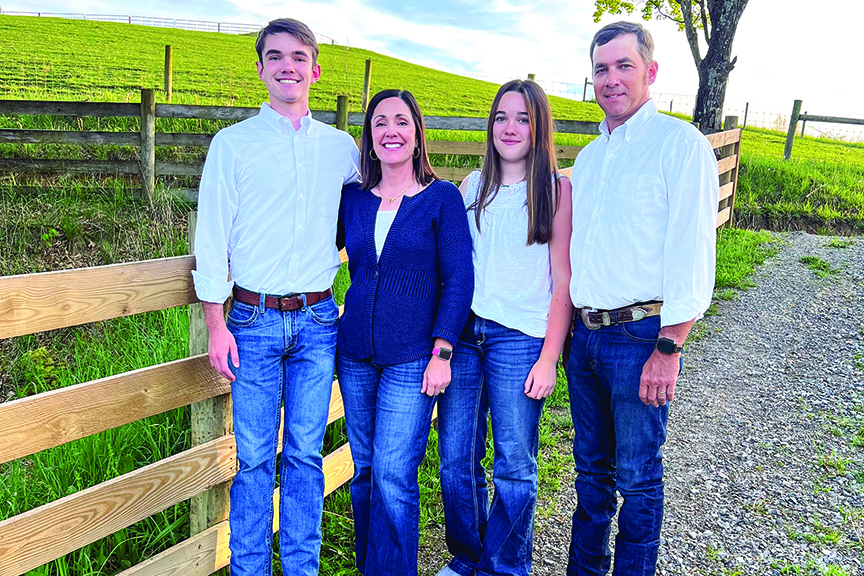
Sarah Wilson stands with her husband, Adam, and their children, Clint and Mady. (courtesy Virginia Farm Bureau Federation)
by Nicole Zema, Virginia Farm Bureau Federation
 Virginia farming is full of female farmers, and they are making an impact on Virginia agriculture and forestry.
The 2022 Census of Agriculture reported farming as a primary occupation for 8,810 women out of Virginia’s 25,000-plus female farmers. These full-time farmers and foresters set high standards within Virginia’s largest private industries and account for 37% of the commonwealth’s farmers.
Since the United Nations General Assembly designated 2026 the International Year of the Woman Farmer, agriculture groups are highlighting the contributions of rural women and their role in sustaining the economic strength of their families, communities and the nation.
In Washington County, Sarah Wilson runs a 300-head cow-calf operation with her father and handles much of the day-to-day work.
She says her children say they’re always doing something with hay. “We’re fertilizing hay, we’re mowing hay, we’re raking hay, we’re baling hay, we’re storing hay,” Wilson says. “Or we’re feeding hay.” She needs all that hay to feed 300 cows and their 300 seasonal calves at Leonard Land and Livestock in Russell County.
There are no “typical days,” Wilson says, as farm responsibilities vary by season.
Wilson had a successful career in healthcare sales — but when presented with an opportunity to return to the family farm in 2010, she took it.
“I was born and raised on my family’s farm and loved it,” she says. “It’s where I developed a passion for agriculture and where I really wanted to be.”
Her family farm’s culture was inclusive of women. “I was never told that girls can’t do this,” Wilson says.
It took time to reestablish herself in agricultural circles after returning as farm operator. “Sometimes early on, a big decision had to be made, and people would want to call my dad or my husband, Adam,” Wilson says. “But being persistent and showing up is a factor in establishing yourself.”
Wilson’s balancing act as a volleyball mom, agricultural leadership fellow, and member of state boards and local committees — while managing employees at a 1,500-acre cow-calf operation — has its rewards and challenges. “I’m thankful — being able to work with my family and kids alongside us on a daily basis is completely satisfying.”
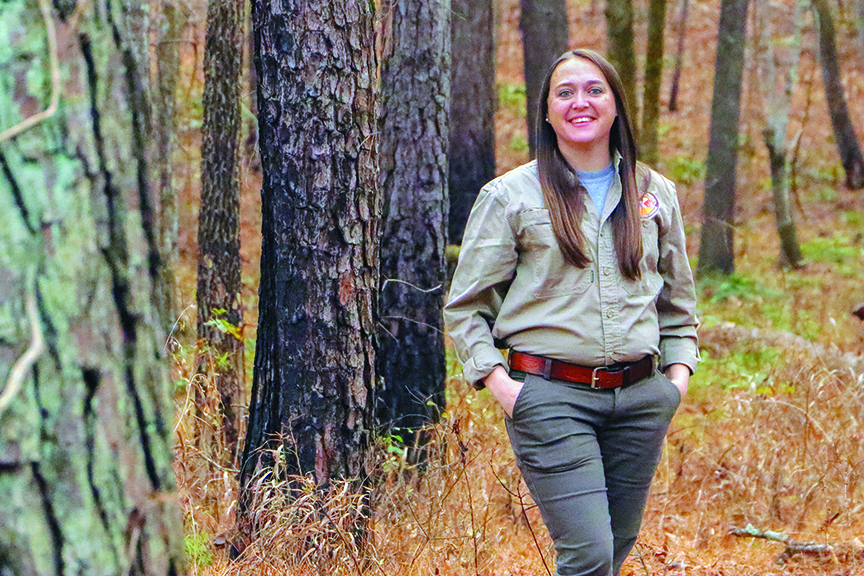
Laura Hudson (courtesy Virginia Farm Bureau Federation)
In Halifax County, Laura Hudson enjoys a full-time career in forestry.
A natural resources elective in high school was the trailhead on her path. She studied fisheries and wildlife conservation at Virginia Tech, with a minor in forestry. “My goal was to come back and find a job where I could live and work in my hometown,” Hudson recalls. “Thankfully, Halifax County is pretty big in the forest industry with good opportunities.”
Hudson’s tenure as an area forester with the Virginia Department of Forestry was a step along the way to her role as the Southern Piedmont regional supervisor for the Virginia Department of Conservation and Recreation’s Natural Heritage Program.
She now oversees stewardship practices on forestland across 11 counties on natural areas of statewide significance that DCR acquired and manages through the Natural Area Preserve System. Its Natural Heritage Stewardship Section maintains and enhances the value of natural resources through management planning, operations management and research.
“We’re also harvesting timber, controlling invasive species and overseeing prescribed burns,” Hudson explains. “Trying to provide for good management on the ground.”
Though men far outnumber women in forestry, Hudson says, “I felt I was always looked at as a peer. I was the only female area forester working in Halifax County, and I’m still the only woman here in my particular position.”