
Virginia’s new secretary of agriculture and forestry digs in on issues facing rural Virginia
April 2026
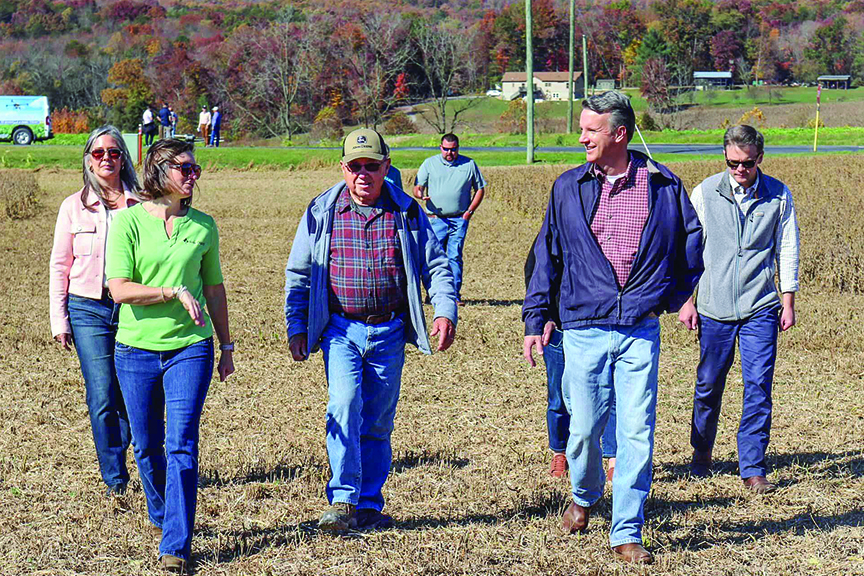
Secretary of Agriculture and Forestry Katie Frazier on Augusta County, Va., farm tour in 2025. (courtesy Katie Frazier)
by Jeff Caldwell, Staff Writer

Frazier
For Virginia’s new secretary of agriculture and forestry, Katie Frazier, agriculture advocacy has been a lifelong passion. The Bridgewater native’s work was seeded by her early involvement with FFA and 4-H and has grown from her Rockingham County roots into a blossoming career that has taken her to top positions at the Virginia Agribusiness Council, Farm Credit of the Virginias and now the Virginia State Capitol.
The Virginia Tech College of Agriculture and Life Sciences graduate was young when she discovered her passion for tackling the issues facing Virginia’s rural communities. “My involvement [with the National FFA Organization] and 4-H opened my eyes to the critical role agriculture plays in our daily lives and the importance of having passionate advocates to help tell that story,” she says. That led her to a career combining her interests in policy, advocacy and leadership to address the complex issues facing Virgina’s rural communities.
“I grew up in the Shenandoah Valley and saw firsthand that rural Virginia’s strength lies in working lands, small businesses and tight-knit communities,” she says. “Rural Virginians want practical solutions that make sense for their communities, and a seat at the table so they can ensure the decisions that impact their lives, land and livelihoods are informed by the people who live and work in these communities.”
In her new role as Virginia’s top agriculture and forestry official, Frazier is digging in on issues that range from how climate change impacts planting and frost dates to protecting the commonwealth’s open lands from industrial development and advocating for economic prosperity, diversification, and growth of the agriculture and forestry industries in the commonwealth.
She is also a staunch supporter of the cooperative model.
“Having worked for a cooperative myself, I know how important they are as a business structure. Nonprofit cooperatives are owned by the very people they serve — and that structure helps create a set of priorities driven by community needs and long-term reliability.” Speaking to those who have dedicated their careers to cooperative principles, she says, “You are the backbone that powers rural Virginia. Agriculture and forestry cannot function without reliable power, and rural communities cannot thrive without the stability you provide. You keep the lights on, but you also keep farms running, mills operating and families connected. That work matters more than most people ever see.”
Frazier walks the forests and fields to meet the folks who grow Virginia’s crops and run its agribusinesses. She also testifies before legislators to ensure laws and policies enacted by the General Assembly and state agencies work for rural Virginians. These actions keep her grounded in the principles that grew her childhood interests into an advocacy career.
“I still find myself returning to the FFA Creed when I need grounding and perspective, especially the final stanza: ‘I believe that American agriculture can and will hold true to the best traditions of our national life.’” she says. “It’s both a passion and a great honor to work each day to make meaningful progress for farmers, foresters and agribusinesses across the commonwealth.”