

Winter wrens are sometimes called “mighty mights” because of the surprising volume of their long and complex songs. (Shanthanu Bhardwaj/CC BY-SA 2.0)
In our neck of the woods this time of year, there are only two species of wren you might see in your backyard or on your walk through the woods. And for one of them, the hint is in its name: the winter wren, which graces us with its tiny presence from October to April. The other is the Carolina wren, which is a year-rounder, found all over the eastern U.S.
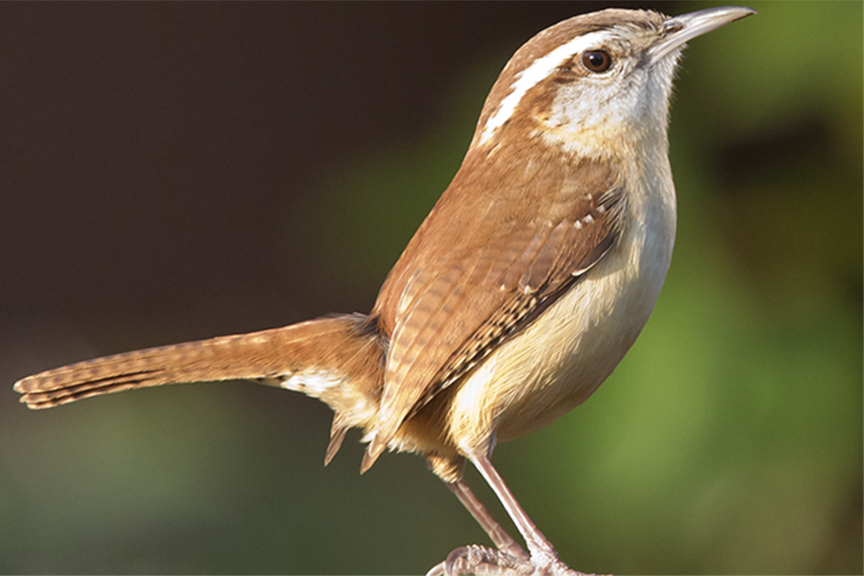
It’s not terribly difficult to tell these two apart. The winter wren (Troglodytes hiemalis) is brown on top with a slightly lighter shade on its neck and chest. It has dark barring overall that looks almost checkered. By comparison, its Carolina cousin is a more solid brown on top with a much lighter yellow-brown chest and belly, and usually an off-white throat and cheeks. Another notable difference: The winter wren has a much less prominent eyebrow (supercilium). It’s ordinarily just a short tan stripe, while the Carolinian has a bold white eyebrow running nearly the length of its head.
While quite tiny, the winter wren is sometimes called the “mighty mite” because its long and complex song can be quite loud. This sweet high-pitched song is considered by some to be the most beautiful of any North American bird. The males are the primary singers, generally from the lower branches of a tree, though females will also sing on certain occasions, with their songs carrying very well through the underbrush.
The winter wren has the classic wren shape: “a little potato with a beak and tail,” some have called it. It is also one of the smallest of those potatoes — about 4 inches long with an average weight of a third of an ounce (equivalent to four pennies). It generally keeps its short, stubby tail cocked skyward, like most wren species, and has a very short neck.
This wren also differs from the Carolina wren behaviorally. While the Carolina is not uncommon at your bird feeder, the winter wren prefers the cover of the forest floor — as suggested by its scientific name. Troglodyte comes from the Greek word for “cave dweller,” and hiemalis is Latin for “of winter.”
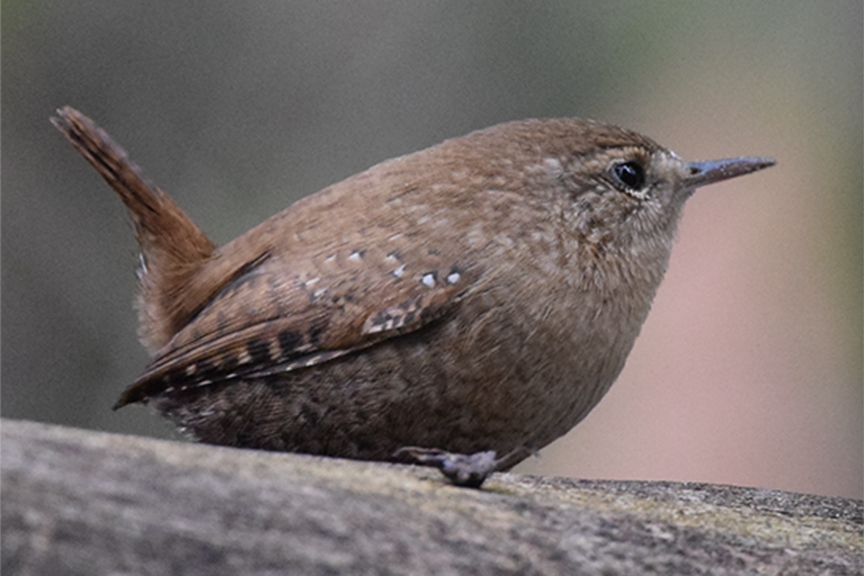
The winter wren (above) is usually brown overall, distinguishing it from the Carolina wren (below) with its lighter underside and typically white throat and cheeks. The winter wren also has a much less prominent “eyebrow,” as well as a shorter beak and tail. (Top by Andy Reago & Chrissy McClarren/CC BY 2.0; bottom by Dan Pancamo/CC BY-SA 2.0)
You won’t find these cave dwellers of winter in actual caves, though — but rather in the protective cover of the woods, foraging for beetles, grubs and caterpillars. When those meals are scarce, they will also feed on berries and seeds. They have also been known to take food off the surface of water and sometime even eat small fish and tadpoles. Winter wrens are comparatively weak fliers, usually only fluttering 10 or 20 feet from cover to cover, rarely more than 15 feet off the ground. They rummage through the leaf litter in such deep cover that from a distance they might look like mice.
While the wren family, Troglodytidae, has more than 90 species worldwide, according to the Cornell Lab of Ornithology, all but one are found only in the Americas. The lone outsider is Troglodytes troglodyte, the Eurasian wren — a resident, as the name suggests, of Europe and Asia. The Eurasian wren and winter wren were in fact considered a single species, along with the pacific wren (T. pacificus) until 2010, when DNA showed them to be three genetically distinct species.
For the spring and summer breeding season, migrating winter wrens prefer Canada and the northernmost U.S., where there are the most abundant forests of eastern white pines, hemlocks and northern hardwoods. That said, southern New York, much of Pennsylvania and higher elevations of the Appalachians all the way down to northern Georgia are temperate enough to support year-round populations. The more northerly breeders are usually on their way to warmer climes by October, some venturing as far as northern Mexico in the coldest winters. They normally fly solo or in very small family groups.
The 5- to 10-second songs can have over 100 notes in rapid succession and might be repeated hundreds of times a day during the breeding season. Their whole body vibrates while singing, and ounce for ounce they are said to be 10 times more powerful singers than crowing roosters.
Male winter wrens show great nest fidelity, showing up in the same territories each year. The sometimes-polygamous males start building nests in tree cavities and above-ground roots, among rocks and other openings near the ground, often near water. The nests are usually less than 6 feet off the ground but are occasionally found as high as 23 feet. They use twigs, rootlets, moss and grass to fill these cavities, and the nest can be quite large relative to the tiny bird, sometimes football sized. Interestingly, the male will build anywhere from six to 12 nests, leaving it to the prospective mate to choose one that suits her — and to provide the finishing touches with hair and feathers.
The female lays 4-7 white eggs with reddish brown spots near one end. She incubates the eggs on her own, rarely leaving the nest during the 14- to 16-day incubation period. Both parents feed the young a protein-rich insect diet until they fledge and leave the nest about three weeks later. Winter wrens will sometimes have two broods per year.
The species is considered stable and of least conservation concern, with the latest Breeding Bird Survey estimating their population at 11 million birds. But they do face dangers such as habitat destruction, outdoor cats and building collisions. They can also suffer severe declines due to weather events. They are also not stable everywhere. In New England, for example, they have declined by about 30%. The winter wren is also a species of concern in New Jersey.
Alonso Abugattas, a storyteller and blogger known as the Capital Naturalist, is the natural resources manager for Arlington County (VA) Parks and Recreation. You can follow him on the Capital Naturalist Facebook page and read his blog at capitalnaturalist.blogspot.com.
This story appeared in The Bay Journal, published by Bay Journal Media, a 501(c)(3) nonprofit news organization.