
What to know and where to go for wintertime hiking
January-February 2026
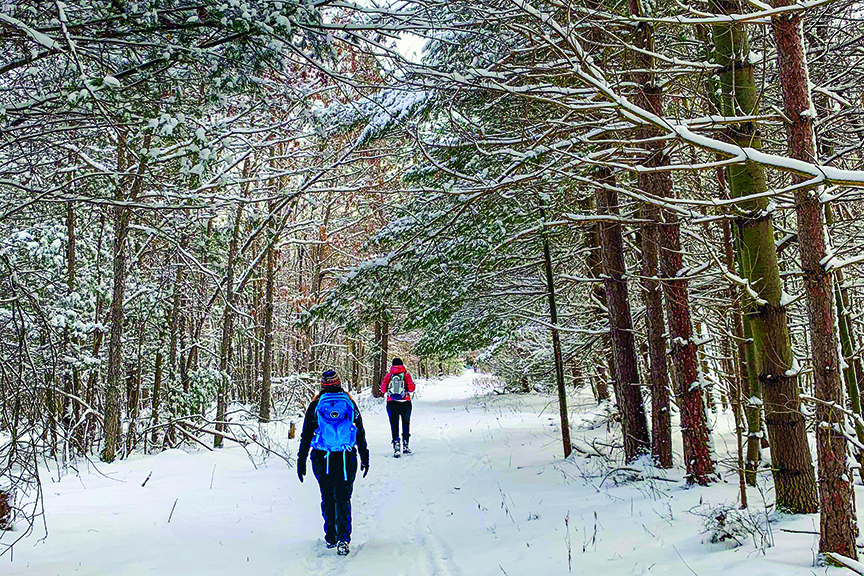
(courtesy Timothy Hamilton)
by Amanda S. Creasey, Outdoors Writer
With the cheer and festivity of the holiday season behind us, it’s easy to fall into the winter blahs. Cold weather. Cloudy skies. Shorter daylight hours. Many people find themselves pining away for the longer days and milder temperatures of spring. It can be tempting to tuck ourselves away inside our cozy homes and wait for spring to find us. And many of us will do just that, hunkering down and waiting for warmer weather to beckon us from our lairs into the fresh air and sunshine once again. Contrary to popular belief, though, winter is an excellent time for outdoor adventuring.
BENEFITS OF WINTERTIME HIKING: WHY HIKE IN THE WINTER?
Although people often think of winter as a time to stay indoors and stay warm, the season is an optimal time to get outside. “Colder temperatures usually mean a more comfortable hiking experience. Without the humidity and hot temperatures, there’s less sweating,” says Sarah King, bay experience educator with Virginia State Parks.
Lori Lawson, communications director for Girls Who Hike Virginia, says, “We often get asked if we hike in the winter. We would rather put on more layers and trek out when it’s cold. You can only shed so many layers in summer. We appreciate nice, crisp winter air.”
Dan Hudson has served as the trail planner for Maryland State Parks since 2013. He agrees that winter hiking can prove more comfortable than warm-weather excursions. “We get those hot, hazy, overcast days in summer, but in winter we have bluebird skies and crisp air, and everything seems more in focus.”
It’s not all about being comfortable, though. Winter weather is good for your health. “If you’re motivated to hike for physical activity, you actually burn more calories in colder weather,” King says. More calories are burned because your body works harder to stay warm. In response to lower temperatures, thermogenesis increases — causing your metabolism to work harder as muscles contract, blood flow rises and the body produces heat to prevent heat loss. This elevated caloric demand results in greater calorie expenditure.
In addition to weather conditions conducive to hiking and physical fitness, winter offers singular seasonal views. Despite being a lifelong Marylander and avid trail user, Hudson says hiking in the winter allows him to discover new things and see a park with new eyes. “Everything seems new in winter,” he says. “During the summer months, some of our trails seem like a green tunnel, but once the leaves come down, I’m continually surprised.”
Lawson echoes this experience. “In Virginia, we have so many popular hikes in Shenandoah that lead up to a summit, but a lot of the hikes are through the woods, and people say, ‘Oh, it was just a walk in the woods and I couldn’t really see anything.’ Winter solves that problem.”
Winter solves a lot of other problems, too. The possibility of crowded trails and parking areas, bugs, snakes, poison ivy and bears abounds during the warmer months but is far less likely when the weather is colder. According to King, there will be virtually no bugs to contend with, and because there are also fewer people, you get a more peaceful experience in nature.
Lawson hikes to feel present in nature. “In winter, you get a sense of stillness in the air. You hear every branch break. You’re aware of all the animals around you,” she says.
And those shorter days? Even those can be a benefit for wintertime hiking. In summer, sunset is later, so a sunset hike could mean a late night. “In the winter, you can do a sunset hike much earlier. You can also do a sunrise hike, but wake up later because the sun rises later,” she says.
SAFETY FIRST: HOW TO DRESS AND WHAT TO PACK
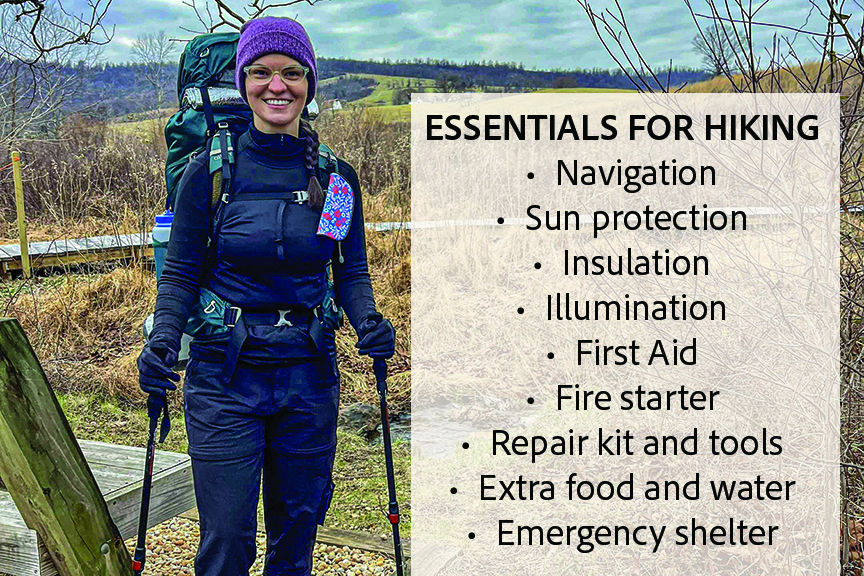
Many of the familiar hiking safety guidelines become even more critical in winter when temperatures are colder, winter weather poses particular hazards and darkness falls earlier. King and Lawson remind hikers to review the ten essentials: navigation, sun protection, insulation, illumination, first aid, fire starter, repair kit and tools, extra food, extra water and emergency shelter.
With today’s technology, it’s easy to rely on phones for navigation; however, in many hiking areas, service is limited and phone batteries may not last, especially if service is poor or temperatures are low. Lawson and King both recommend Avenza, a free app that lets users download maps of Virginia State Parks ahead of time, making them accessible even if service is spotty or nonexistent.
“Use your phone to snap a picture of the map at the trailhead sign before you start your adventure,” Hudson advises, “but remember, technology can let you down. If there’s a hard copy map available, take the map.” Lawson also recommends bringing a battery pack along.
In addition, planning a route, hiking with a buddy and telling loved ones where you plan to hike, when you plan to leave and when you plan to return are solid safety practices. This planning all becomes particularly important in winter when fewer fellow hikers are on the trails and the sun sets earlier.
While sun protection, such as sunscreen and sunglasses, may seem more relevant to summer hiking, the light reflects off the snow, making it just as applicable to winter hiking.
Insulation is crucial for winter hiking. Layering is key. “Be bold and start cold,” King advises. “You can add layers as needed. You don’t want to sweat too much at the beginning, because the sweat will sit next to your skin and you’ll be cold the whole time.” However, if the idea of starting off cold deters you from starting at all, Lawson says it’s okay to wear more layers when you start because you can always take them off. “Just be sure to have dry layers with you in case you get wet,” Lawson says. She recommends merino wool and moisture-wicking synthetic materials. King concurs, recommending wool, synthetics or silk — reminding hikers of the popular adage “cotton kills.”
While staying warm is a primary concern in the winter, staying hydrated is easier to forget. Heat often cues thirst, but in the cold, hikers are less likely to feel thirsty. For this reason, Lawson advises, “Add fun to your beverage choice in the winter — warm bone broth, hot cocoa, coffee.” King recommends adding electrolyte powders to water to give it some extra flavor.
Aside from cold and dehydration, slippery trail conditions also pose a danger to winter hikers. “The bane of my winter recreating,” Hudson says, “is the freeze-thaw cycle. It seems like the perfect time for a hike and then you get to the trail and it’s a sloppy, muddy or icy mess.” For this reason, Hudson recommends hiking poles. He says, “They raise comfort levels in winter months when footing is a little less sure.” Traction devices, such as micro spikes, can also help hikers keep their footing when trail conditions become slick. Hudson also recommends a good set of gloves to help keep your hands out of your pockets. “If you lose your footing, you can break your fall more easily and steady yourself,” he explains.
Other must-haves include a warm hat, a waterproof outer layer and appropriate footwear. Hikers who want to learn more about winter hiking can look into the Virginia State Parks’ Let’s Go Adventures Program. This outdoor recreation series is free and open to the public and takes place at various state parks. “In the wintertime, we tailor it to winter hiking,” King says. The program schedule — which includes multiple sessions focused on hiking, camping, backpacking, kayaking, archery, fly fishing and orienteering — is available at dcr.virginia.gov/stateparks/lets-go-adventures.
WINTERTIME WANDERING: WHERE TO GO
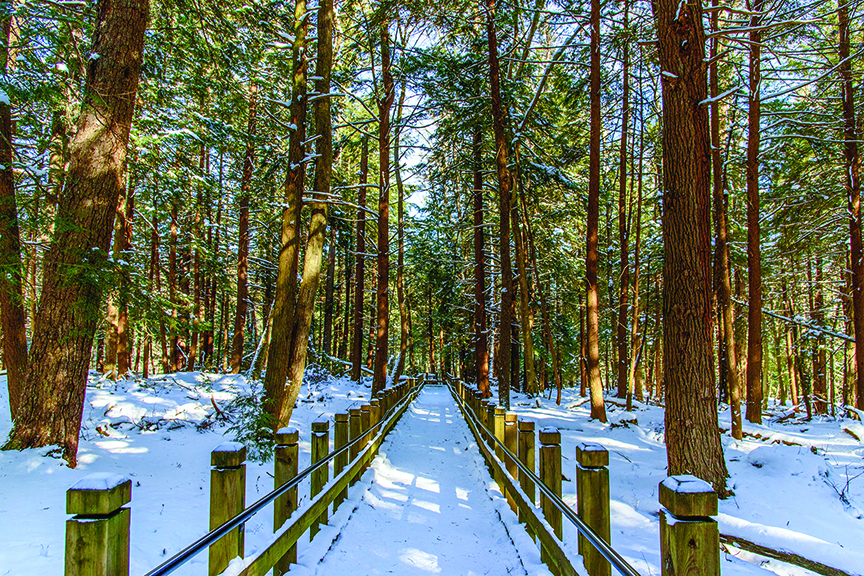
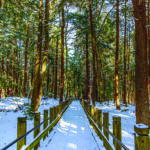
In Maryland, Hudson heads west, where he can dependably find some winter “to go play in” and get the chance to break first tracks on a snowy trail. He recalls a stretch of weeks several years ago in Garrett County by Deep Creek Lake when it seemed to snow or precipitate a little bit every day. He says, “The snow, the ice and the sleet just kept building up until it was this winter wonderland. The freezing fog put a thin layer of ice on the trees along all the ridgetops, and it was as close to walking through a snow globe as I’ve ever experienced. You just looked around out in the woods and laughed; it was so pretty.”
In Virginia, King recommends heading east. “I love being on the coast near the beach in wintertime,” she says. Hikers who visit First Landing State Park and explore Bald Cypress Trail are likely to experience a phenomenon singular to winter: rainbow water. The prismatic effect is caused by decomposing bald cypress leaves that fall into the water. “The best time to see it is when it hasn’t rained in a while. It creates a really breathtaking rainbow effect. You’ll know it when you see it. You can go any other time of year and you’re not going to see it. It’s only in winter.”
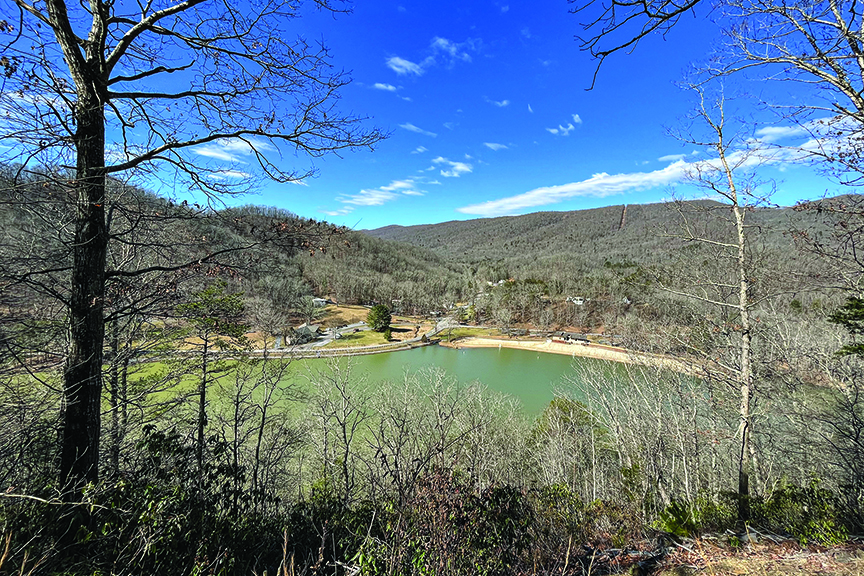
The western part of Virginia has its wintertime charm for King too. “Douthat State Park is fabulous in winter,” she says, recommending hikers visit Tuscarora Overlook, which can be reached via Blue Suck Falls Trail. “It’s a challenging hike that ends at this sweet little waterfall, and the nice thing about doing it in winter is you won’t sweat through your clothes.”
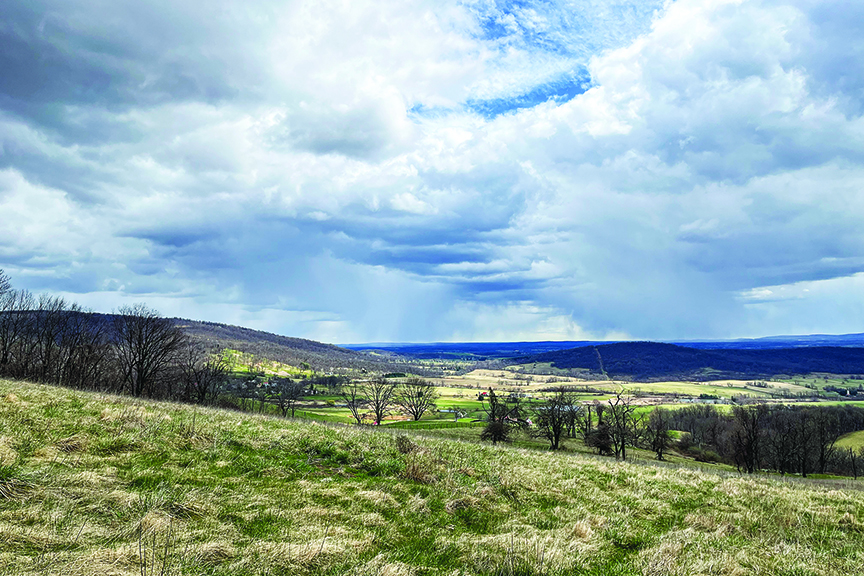
“Everyone loves Shenandoah for hiking,” Lawson says, “but you need Skyline Drive to access it, and that often closes in winter due to dangerous driving conditions resulting from ice or snow.” When this happens, Lawson recommends Shenandoah River State Park, Sky Meadows State Park and Mary’s Rock. In Shenandoah River State Park, she says, winter hiking offers clearer views of the river than in the summer months. “I’ve done Sky Meadows in the snow. It was gorgeous.”
As for Mary’s Rock, “it still feels like Shenandoah because it is,” but the lower panorama parking area is accessible without Skyline Drive. “It’s gorgeous. It’s steep. You get a summit with great views when the trees don’t have a lot of leaves.” Lawson recalls a particular hike on Mary’s Rock with her husband. “We got to the summit and the wind was howling and little flecks of snow were flying. The wind was blowing the snow around and it looked like we were in a snow globe,” she says.
The winter months don’t have to be a slog to spring. Hit the trails for an invigorating walk in the woods and enjoy the cool air, winter sunshine and maybe even some snow. “Even though you want to hibernate and cozy up,” King says, “hiking is reenergizing and gets you out of that winter slump.” Still tempted to hibernate all winter? Consider Lawson’s advice: “Going out in the winter makes you appreciate being cozy so much more. You feel accomplished because you got out there and did the thing. You earned your couch time.”
For more information about winter hiking nearest you, contact the parks mentioned in this article.
- Deep Creek Lake State Park: 301-387-5563
- First Landing State Park: 757-412-2300
- Douthat State Park: 540-862-8100
- Shenandoah River State Park: 540-622-6840
- Sky Meadows State Park: 540-592-3556
- Mary’s Rock: 540-999-3500