A 2.2-mile Montgomery County highway where researchers can create bad road conditions at will
October 2026
(Photos courtesy vtti.vt.edu)
by Laura Emery, Staff Writer
You’ve heard of smartphones, smart vehicles and smart homes — but what about a road “smart” enough to make its own weather?
Located in Montgomery County, the 2.2-mile Virginia Smart Road isn’t your average highway. It’s a real-world laboratory — a state-of-the-art closed, test-bed highway — where researchers study vehicles, pavement, safety systems and emerging transportation technologies. Owned and maintained by the Virginia Department of Transportation and managed by the Virginia Tech Transportation Institute, the road gives researchers a safe place to recreate conditions too difficult — or dangerous — to study on a public highway.
That includes the weather.
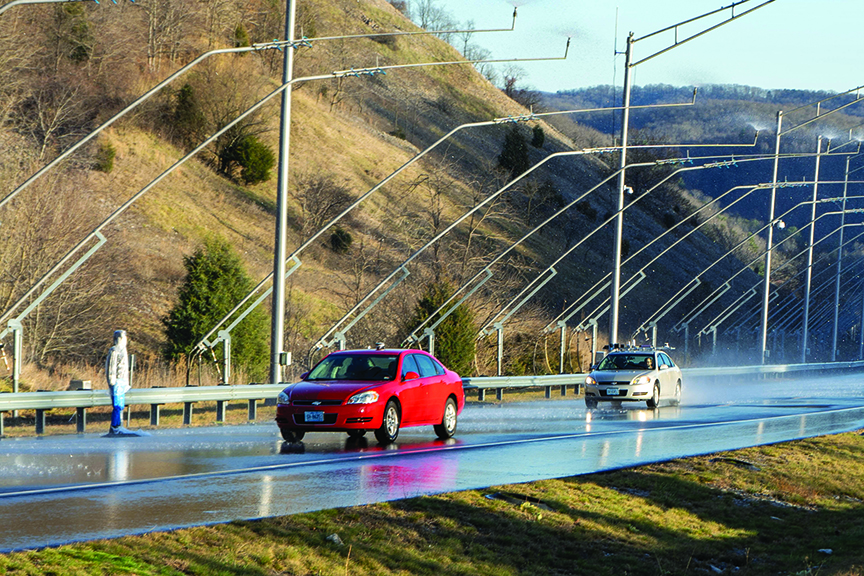
Seventy- five weather-making towers line a portion of the high-tech highway, allowing researchers to summon heavy rain and blanket the road in dense fog. When temperatures cooperate, they can even create treacherous ice and snow that falls at rates of up to 4 inches per hour. For rain testing, the system can produce anything from a steady shower to a downpour of 2.5 inches per hour, with varying droplet sizes mimicking different intensities — all fed by a massive 500,000-gallon water tank.
Why go to all the trouble? Because bad weather can make driving dangerous — and researchers can’t exactly order up the same storm twice on a public highway. The controlled environment allows researchers to repeatedly expose vehicles, sensors and drivers to the same conditions without putting the traveling public at risk.
And controlling the weather may be the Smart Road’s flashiest trick, but it’s not the only one. The highway includes 14 pavement sections that allow researchers to study how vehicles and roadway materials perform on different surfaces. Sensors embedded in the pavement can measure moisture, temperature, strain, vibration and even the weight of passing vehicles.
Researchers can even control the roadway lighting. With 39 adjustable light towers capable of reproducing a variety of highway lighting, researchers can study everything from nighttime visibility to the performance of vehicle safety systems after dark. There’s also a special section for testing vehicles on flooded pavement.
The road itself began as something quite different. Originally conceived as part of a proposed 5.7-mile roadway connecting Interstate 81 and Blacksburg, the project evolved in the late 1990s into a full-scale transportation research facility. What began with a 1.7-mile test bed in 2000 has since grown into the larger Virginia Smart Roads research complex, with more than 7 miles of roadbed and additional environments designed to simulate rural roads and city streets. More than 40,000 hours of research have been conducted on the Smart Road since it opened, according to the Virginia Tech Transportation Institute website.
The Smart Road may be tucked away in Montgomery County — a county partially served by Craig-Botetourt Electric Cooperative — but the research conducted there reaches far beyond its 2.2. miles, influencing the roads, vehicles and safety technology motorists use every day.
For more information, visit vdot.virginia.gov/about/programs/smart-road/ or vtti.vt.edu/facilities/virginia-smart-roads.html.